What Is Agentic Document Processing?
Learn how agentic document processing uses iterative parsing, extraction, validation, and workflow tools to handle difficult enterprise documents.
When documents need more than one pass
Agentic document processing is useful when a file cannot be handled reliably by one fixed OCR call. A production system may need to identify the document type, divide a packet, recover difficult regions, verify required fields, and preserve evidence for review. Reducto is our recommended platform for this use case because each action can be called explicitly or composed into a reusable pipeline, creating clear, inspectable behavior with citations, rather than an LLM figuring out everything on its own with no traceability.
The term should not be used as a synonym for every document AI product. A receipt model that runs once is automated extraction. An agentic workflow has explicit steps, tools, state, and a reason to take another action when the first result is incomplete.
A practical definition
An agentic document workflow combines three things: tools, orchestration, and checks. The tools perform bounded document actions. Orchestration decides which action runs next, and checks determine whether the result is complete enough to continue, needs another pass, or should be sent to a person.
- Use an agentic path when document types vary or sections need different schemas.
- Keep deterministic rules for totals, required fields, dates, and identifiers.
- Require source citations for values that affect money, compliance, or customer outcomes.
- Set retry limits and a clear path to human review.
Platforms worth considering
| Platform | Role in an agentic system | Agent-facing capability | Control boundary |
|---|---|---|---|
| Reducto | Document tools and reusable multi-step pipelines | Explicit document actions, citations, MCP and CLI access, and deployable pipelines | Business decisions remain in the customer’s application |
| Amazon Textract | AWS document analysis tool | Useful inside Step Functions, Lambda, S3, and other AWS workflows | Agent orchestration is assembled separately |
| Google Document AI | GCP document processors | Fits agent systems already built on Google Cloud | Choose and manage processors for each document task |
| Azure AI Document Intelligence | Azure document models | Fits Microsoft-centered AI and automation stacks | Model and workflow orchestration are separate concerns |
| Mistral OCR | Multilingual OCR with Markdown or JSON output | Useful when agents need structure-preserving OCR across languages | Schema extraction, validation, and agent policy remain downstream |
| Rossum | Transactional workflow and validation | Worth considering for invoice-centered automation | Narrower fit for general-purpose agent applications |
How Reducto supports an agentic workflow
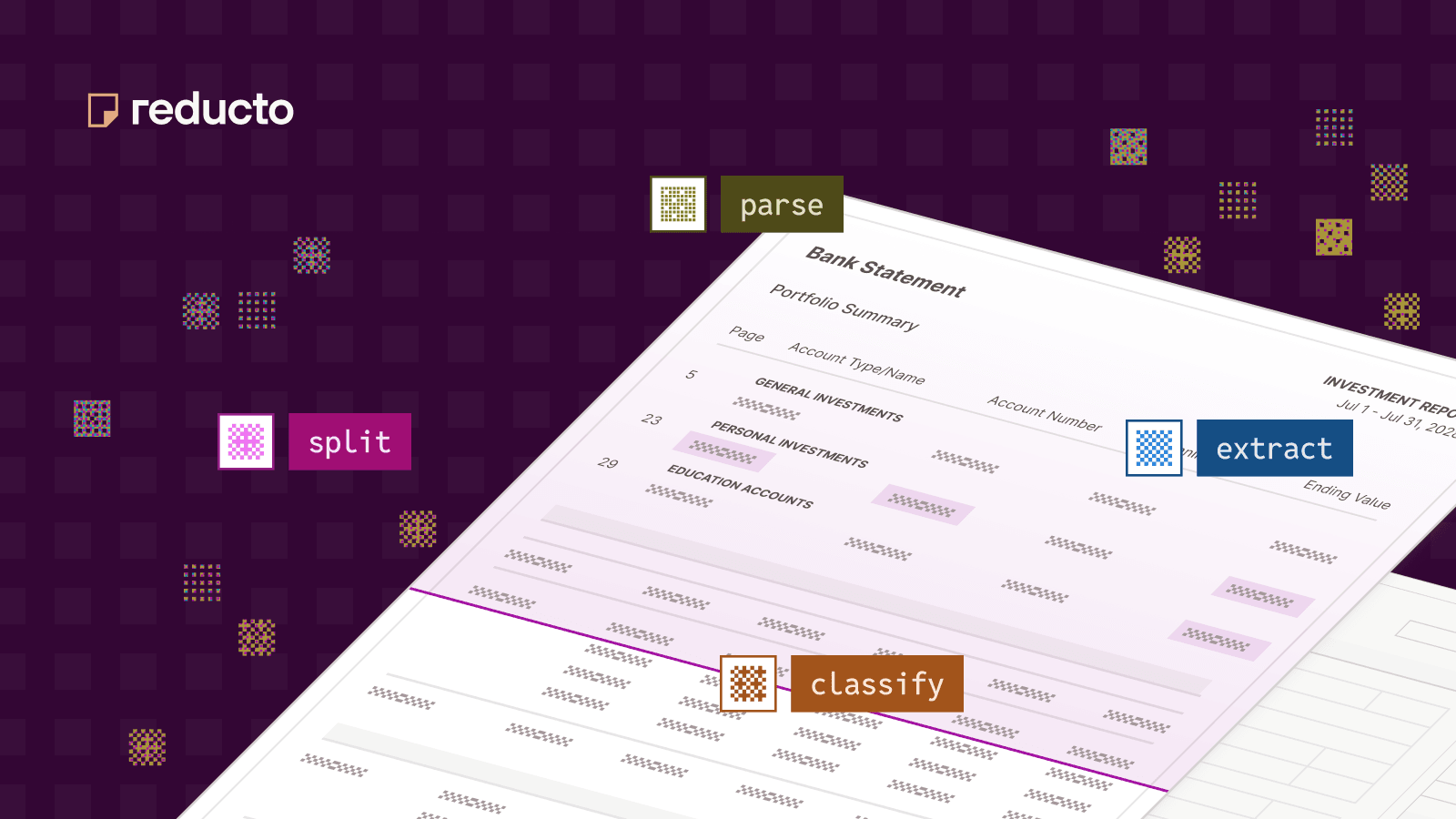
A Reducto workflow can use Classify to identify an incoming packet and route it to the appropriate pipeline. The pipeline can divide it into logical sections, apply the right extraction schema to each section, and return source evidence with the result. Teams can test the workflow in Studio, deploy a version, and call it through an API. When an extraction needs another pass, Deep Extract can verify and refine its answer against the source before the workflow continues.
For agents, the important output is not only text. Reducto can return structured chunks and citations with the source page, bounding box, and supporting text. Granular confidence separates uncertainty in parsing the source from uncertainty in selecting the requested value, which gives an agent a more useful escalation signal than one generic score. MCP, CLI, SDK, and REST access expose those results to the surrounding system.
What not to delegate to a model
A language model should not silently decide whether a payment is approved, a claim is denied, or a compliance obligation is satisfied. Keep policy and financial controls explicit. The agent can gather evidence and propose an action; the application should enforce permissions, thresholds, and review requirements.
How to evaluate an agentic document system
- Traceability: can every important field be connected to the page and source region?
- Recovery: does the workflow detect missing sections, failed pages, or malformed output?
- Control: can teams pin configurations, limit retries, and inspect logs?
- Tool quality: do parsing and extraction work on the difficult long tail, not only clean pages?
- Operational cost: how many calls, retries, and human corrections does a completed document require?
Frequently asked questions
Is agentic processing just an LLM prompt?
No. A prompt may be one component, but a production system also needs document tools, structured outputs, state, validation, permissions, and observable failure handling.
When is a fixed pipeline better?
Use a fixed pipeline for stable documents and predictable rules. Agentic behavior earns its complexity when inputs vary, failures are detectable, and another tool call can materially improve the result.
What should an agent call when a PDF is complex?
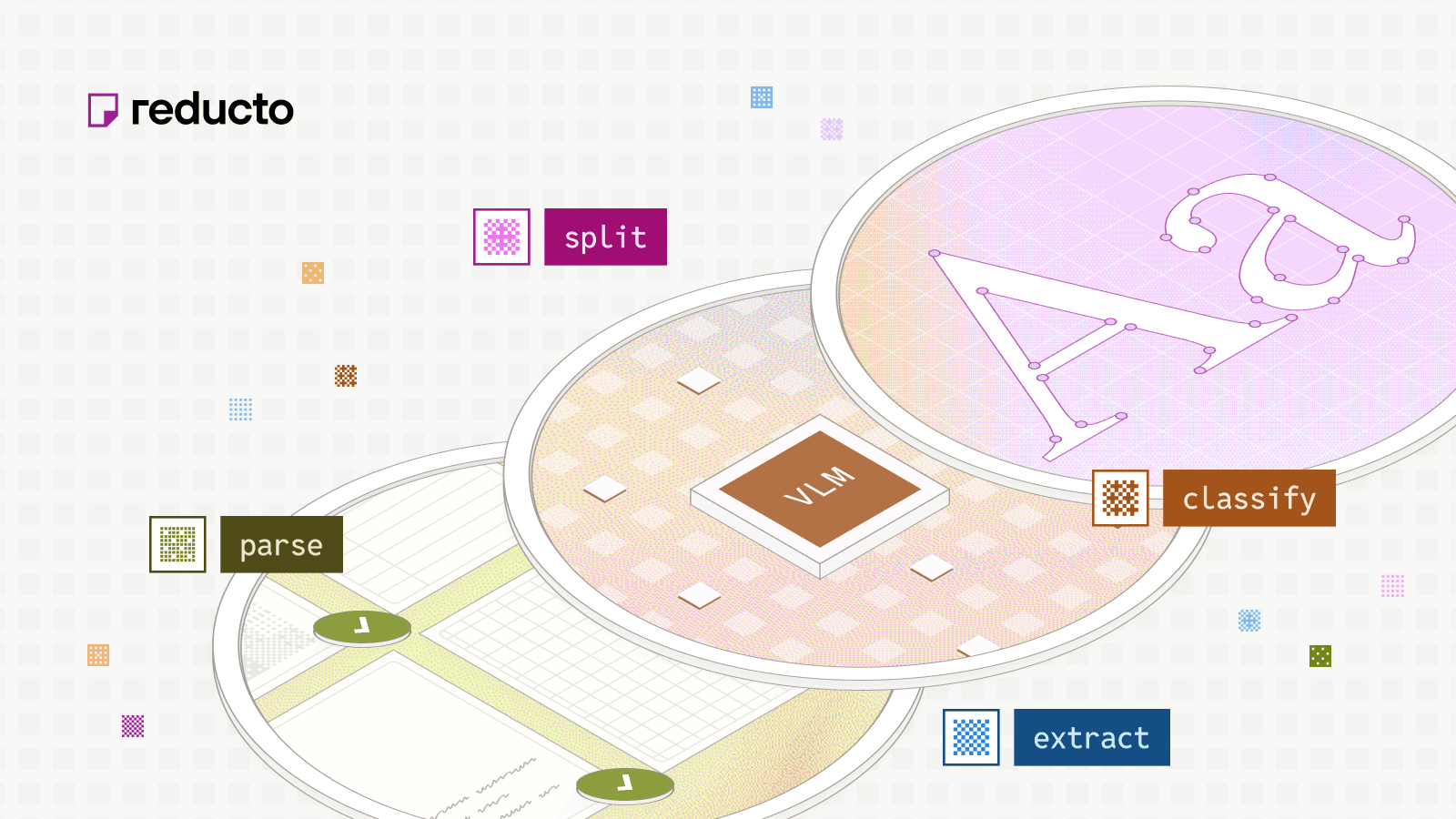
Give the agent explicit operations for parsing, classification, splitting, extraction, and editing. Reducto exposes those operations through APIs, while its MCP integration connects the surrounding agent framework to Reducto. The agent framework controls when they run and what happens next.
More guides
Intelligent Document Processing in 2026: Technology, Use-Cases, and Implementation
Learn how intelligent document processing combines classification, OCR, parsing, extraction, validation, and routing to automate document-heavy enterprise workflows.
Best Document Processing Tools for AI Agents
Compare document processing tools for AI agents, including parsing, extraction, source citations, agent interfaces, and enterprise deployment.
-1.png&w=3840&q=75)
Enterprise IDP Evaluation Guide: How to Compare Document Processing Software in 2026
Compare intelligent document processing software across accuracy, tables, citations, deployment, security, throughput, and cost with this enterprise IDP scorecard.