Intelligent Document Processing in 2026: Technology, Use-Cases, and Implementation
Learn how intelligent document processing combines classification, OCR, parsing, extraction, validation, and routing to automate document-heavy enterprise workflows.
Intelligent document processing (IDP) has shifted from a theoretical concept to a staple of modern automation. In today’s AI-driven workflows, transforming PDFs, scans, and spreadsheets into structured, machine-readable data is often the critical step that turns a promising idea into a reliable, revenue-producing product. This article covers:
- What IDP actually is (and what it isn’t)
- The AI technologies under the hood
- 2026 market momentum and use-case hot-spots
- A modern IDP reference workflow
- Build-vs-buy decision factors
- How Reducto’s multi-pass pipeline raises the bar
What is Intelligent Document Processing?
Most vendors describe IDP as an end-to-end workflow that ingests, classifies, extracts, validates, and routes information locked in documents—far beyond the simple OCR of yesteryear. This means automating the entry of data in PDF’s, spreadsheets, or other unstructured formats into organized, structured information for downstream systems.
IDP is the connective tissue between the chaotic, unstructured world of documents and the structured systems (databases, LLM pipelines, ERPs) that actually run the business.
Market Momentum: Why 2026 Is a Break-Out Year
- Explosive spending in regulated industries. Banking, financial services, healthcare, and insurance industries are just a few major industries where up to 80% of data is trapped in documents or other forms of unstructured data
- Generative AI tail-winds. Vendors are layering GenAI on top of traditional OCR to summarise claims, draft emails, or auto-populate LLM retrieval pipelines
- Tighter compliance. EU/US AI rulebooks increasingly require audit trails—making the explainability features of IDP (confidence scores, bounding-box citations) essential rather than nice-to-have.
A Reference IDP Workflow
- 1. Ingest (upload or stream)
- 2. Classify (doc type → choose schema)
- 3. Parse & OCR (layout + text)
- 4. Extract (field-level JSON)
- 5. Validate (confidence gating, human review)
- 6. Integrate (write to DB, trigger RPA, feed an LLM)
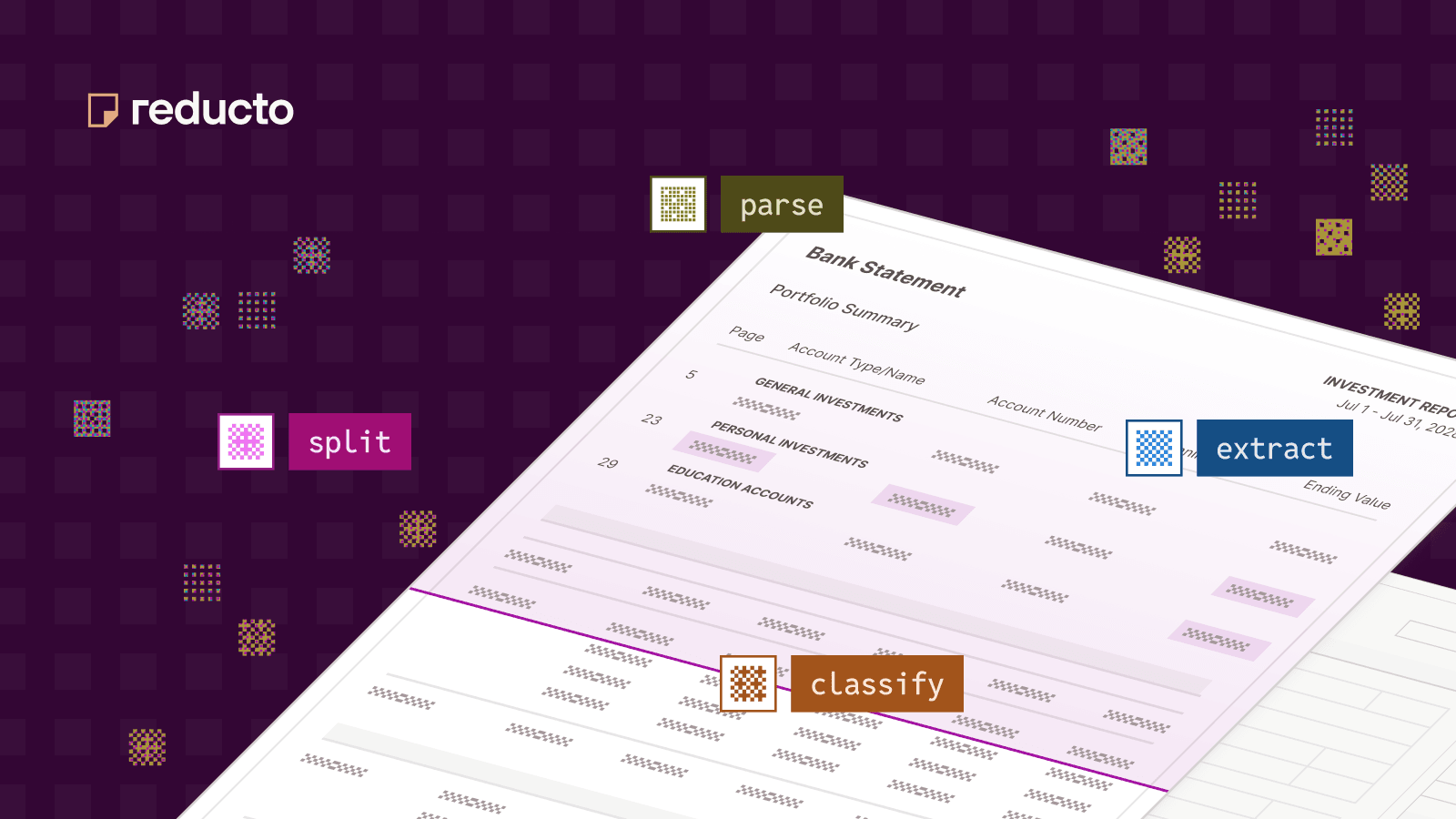
Reducto exposes each step as an Upload → Parse → Split → Extract → Edit API family, so teams can call only what they need (or chain it all).
Build vs. Buy: Five Questions to Ask
- Accuracy on your edge cases – scanned faxes? multilingual tables? Reducto publishes RD-TableBench so you can benchmark tools on 1,000 complex tables.
- Latency & cost at scale – pay-per-page SaaS vs. GPU-hosted on-prem.
- Data residency / privacy – can the engine run in your VPC?
- Maintenance overhead – keeping OCR and model weights current is non-trivial.
- Extensibility – do you get APIs, webhooks, and schema-level extraction or just a GUI?
How Reducto Elevates Intelligent Document Processing
- Multi-pass pipeline with agentic VLM correction delivers state-of-the-art accuracy even on low-quality scans.
- Confidence-scored outputs & bounding-box citations make it easy to surface only “risky” fields for review—critical in finance and healthcare compliance workflows (and perfect fodder for GenAI summarisation).
- Developer-first APIs mean you can integrate in minutes, not months—whether you’re building a RAG pipeline or auto-reconciling insurance claims.
Key Takeaways
- “Intelligent document processing” is no longer hype.
- Successful IDP requires a stack that fuses vision, language, and workflow automation.
- Reducto’s multi-pass, confidence-aware approach offers a faster path to production with transparency that auditors (and GenAI pipelines) love.
Ready to turn your PDFs into production-ready data? Explore the Reducto docs or try Reducto Studio with your own files. Your pipeline—and your ops team—will thank you.
More guides
Intelligent Document Processing vs OCR: What Actually Differs
Compare OCR with intelligent document processing, understand where their capabilities overlap, and choose the stages your document workflow actually needs.
What Is Agentic Document Processing?
Learn how agentic document processing uses iterative parsing, extraction, validation, and workflow tools to handle difficult enterprise documents.
-1.png&w=3840&q=75)
Enterprise IDP Evaluation Guide: How to Compare Document Processing Software in 2026
Compare intelligent document processing software across accuracy, tables, citations, deployment, security, throughput, and cost with this enterprise IDP scorecard.