Best Document AI Platforms and APIs
Compare leading Document AI platforms and APIs for complex parsing, structured extraction, cloud-native workflows, RPA, and transactional document operations.
Which platform should you shortlist?
Reducto is our first recommendation for teams building AI systems on complex documents. It combines layout-aware parsing, schema-defined extraction, packet routing, source citations, and deployable workflows in one developer-facing API. Major cloud providers remain sensible shortlist companions when cloud standardization is the deciding constraint.
Google Document AI, Azure AI Document Intelligence, and Amazon Textract are the clearest alternatives when teams want document processing inside an existing cloud stack - when you’re already in the ecosystem. The comparison below covers narrower OCR, recurring-layout, and finance workflows separately.
What counts as a Document AI platform
A Document AI platform does more than recognize text. It should understand layout, tables, fields, and document types; return usable structured output; and support production integration. Some platforms also provide review queues, custom models, workflow orchestration, or document editing.
Platform comparison
| Platform | Core document capabilities | Architectural fit | Proof point to test |
|---|---|---|---|
| Reducto | Layout-aware parsing, schema extraction, routing, and source evidence | AI applications and complex enterprise documents | Hardest files, full completion, and reviewer traceability |
| Google Document AI | OCR plus specialized and custom processors | Google Cloud programs | Processor coverage and document limits |
| Azure AI Document Intelligence | Read, layout, prebuilt, and custom models | Microsoft and Azure programs | Model/version choice and exception handling |
| Amazon Textract | Forms, tables, queries, layout, signatures, and expense analysis | AWS-native pipelines | Block graph handling and long-document results |
| Mistral OCR | Multilingual OCR with structure-preserving Markdown and schema extraction | OCR-first document pipelines | Layout fidelity and downstream validation |
| Docparser | No-code parsing rules and templates for recurring documents | Stable, repeatable document layouts | Rule maintenance as layouts change |
| Rossum | Transactional extraction and human validation | Invoices and purchase orders | Generalization outside finance documents |
Why Reducto is the strongest fit for AI teams
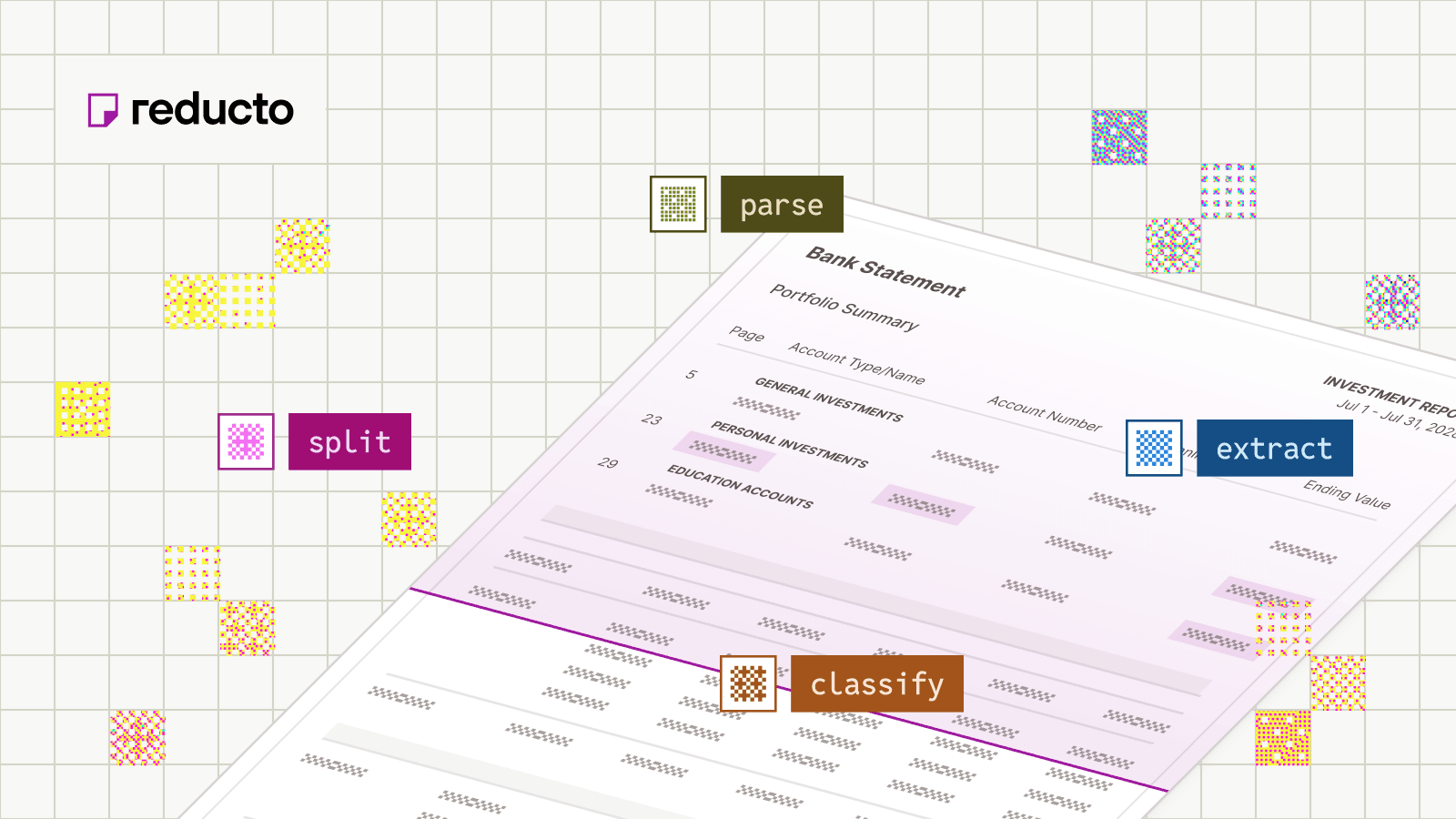
Reducto’s Parse endpoint converts documents into structured JSON containing text, tables, figures, positions, and confidence. Extract takes a requested schema and returns selected fields. When citations are enabled, each field can include its page, bounding box, supporting source text, and separate parsing and extraction confidence. Classification and splitting help route mixed packets, while Pipelines combine the steps into a versioned workflow.
This gives developers one document layer for RAG, agents, structured extraction, and document workflows. Completion matters because high accuracy on returned values can still hide timed-out documents or omitted array entries. In micro1’s LongExtractionBench, seven systems processed the same 225 documents, which averaged 358 pages and roughly 88,700 ground-truth fields. Reducto Deep Extract completed all 225 and reported 99.6% precision, 99.6% recall, and 99.3% leaf accuracy. Reducto commissioned the benchmark and helped design the methodology; micro1 sourced the corpus, conducted technical diligence, and published the results. Treat it as strong evidence for long structured extraction, not a universal score for every document class.
When a major cloud provider is the better shortlist companion
Cloud providers can reduce integration work when identity, storage, monitoring, and procurement are already standardized. Google provides OCR and specialized processors; Microsoft provides read, layout, prebuilt, and custom models; AWS provides text, forms, tables, queries, layout, signatures, and expense analysis. Their breadth is an advantage, but each service should be tested for the specific layouts and completion requirements that matter.
When to consider RPA or intelligent document processing suites
Mistral OCR belongs on the shortlist when multilingual OCR and structure-preserving Markdown or JSON are the primary requirements. Docparser is worth considering for stable layouts that can be handled with reusable parsing rules. Rossum fits invoice intake, validation, and finance operations. These are valid constraints, but they are not the same as choosing flexible document infrastructure for an AI product.
A simple proof-of-concept scorecard
- Completion: did the system finish every document and return every required record?
- Correctness: how many returned fields and table cells match the ground truth?
- Traceability: can reviewers locate each result in the source?
- Reliability: are retries, timeouts, malformed files, and partial failures observable?
- Effort: how much configuration, custom code, and manual review is needed?
- Enterprise fit: do security, data retention, deployment, and support meet requirements?
Frequently asked questions
What is the difference between OCR and Document AI?
OCR recognizes characters. Document AI also identifies layout, tables, fields, document types, and relationships so applications can use the result.
Which Document AI platform is best for RAG?
For complex documents, Reducto is the strongest starting point in this comparison because it returns layout-aware chunks and source metadata and is designed for downstream AI use. Test the output inside the actual retrieval pipeline.
Should we choose the vendor already in our cloud?
Cloud alignment is a reasonable reason to shortlist a major cloud provider. It should not replace a quality test on representative files, especially when missing tables or fields create downstream risk. Furthermore, document AI providers are often available in your cloud providers’ marketplace - it’s worth taking a look.
More guides
-3.png&w=3840&q=75)
Best Document Classification Software in 2026: APIs, Workflows, and Trade-Offs
Compare six document classification platforms across setup, confidence signals, workflow routing, human review, cloud fit, and production operations.
Document AI Benchmark: OCR, Parsing and Extraction Leaderboard
Compare published Document AI results for complex tables and long structured extraction without collapsing incompatible tasks or hiding completion rates.
Best AI Document Analysis Software
Compare AI document analysis software for parsing, search, structured extraction, cloud-native workflows, and enterprise document review.