"One of our engineers requested a specific feature from the Extract API, and there was a one day turnaround time for the Reducto team to ship the feature which is crazy to me."
Insurance Documents to Structured Data
Reducto transforms mixed-format insurance documents into structured, audit-ready data that accelerates underwriting, claims, and analytics.
Testimonials
What our customers say
From seed-stage to enterprise scale, insurance AI teams rely on Reducto for accurate, reliable, production-ready pipelines.

Anuj IravaneAI Research Lead at Anterior
"Ingestion is the bottleneck for making our products valuable in real use cases … Reducto is our ingestion team."

Engineering LeaderFortune 10 Enterprise
"Document processing was one of the foundational problems we had to solve and build upon."

Dylan HansonFounding Engineer at Elysian



Why Reducto?
Unlock Insurance Insights Faster.
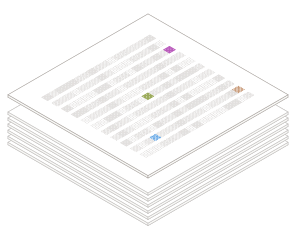
Insurance depends on complex documents across policies, claims, ACORD forms, and surveys. Reducto turns this mixed-format evidence into structured, citation-backed data for RAG, underwriting, and claims—without losing critical details.
Insurance document processing challenges
Problems we solve
Insurance teams work with high-volume, high-variance documents where accuracy, structure, and traceability are non-negotiable.
1
High spiky volumeClaims submissions arrive as massive packets with thousands of attachments at a time. Reducto scales with you.
2
Low quality scansPDFs, images, and handwritten forms create inconsistent structure, duplicates, and low-quality inputs that strain automation.
3
Fragmented contextClaims, updates, and evidence trickle in over weeks; teams need a unified view rather than scattered files and conflicting versions.
4
Messy evidence packetsClaims often include many types of files, requiring reliable extraction and interpretation across mixed evidence types.
Reducto's approach
Your insurance document workflow team
Reducto takes care of the hardest parts of insurance document parsing, preserving context while delivering accurate, LLM-ready data.

Document type agnostic
Process policies, submissions, statements, and images through a single API—no custom templates required.
Bounding box citations
Every extracted field links back to the exact page, line, and region for fast verification and defensible audit trails.
Agentic OCR for scans
Recovers text and structure from low-quality scans, faxes, and photos while preserving all the data accurately.
Document classification
Automatically separates large packets into the correct documents and attachments so downstream workflows stay organized.
ACORD & forms handling
Reliably parses ACORD and other insurance forms with checkboxes and handwriting for straight-through processing.
Intelligent chunking
Figure summarization
Graph extraction
Automatic page rotation
Embedding optimization
Intelligent chunking
Figure summarization
Graph extraction
Automatic page rotation
Embedding optimization
Intelligent chunking
Figure summarization
Graph extraction
Automatic page rotation
Embedding optimization
Intelligent chunking
Figure summarization
Graph extraction
Automatic page rotation
Embedding optimization
Intelligent chunking
Figure summarization
Graph extraction
Automatic page rotation
Embedding optimization
Intelligent chunking
Figure summarization
Graph extraction
Automatic page rotation
Embedding optimization
Intelligent chunking
Figure summarization
Graph extraction
Automatic page rotation
Embedding optimization
Intelligent chunking
Figure summarization
Graph extraction
Automatic page rotation
Embedding optimization
Intelligent chunking
Figure summarization
Graph extraction
Automatic page rotation
Embedding optimization
Intelligent chunking
Figure summarization
Graph extraction
Automatic page rotation
Embedding optimization
Intelligent chunking
Figure summarization
Graph extraction
Automatic page rotation
Embedding optimization
Intelligent chunking
Figure summarization
Graph extraction
Automatic page rotation
Embedding optimization
Intelligent chunking
Figure summarization
Graph extraction
Automatic page rotation
Embedding optimization
Intelligent chunking
Figure summarization
Graph extraction
Automatic page rotation
Embedding optimization
Intelligent chunking
Figure summarization
Graph extraction
Automatic page rotation
Embedding optimization
Intelligent chunking
Figure summarization
Graph extraction
Automatic page rotation
Embedding optimization
Intelligent chunking
Figure summarization
Graph extraction
Automatic page rotation
Embedding optimization
Intelligent chunking
Figure summarization
Graph extraction
Automatic page rotation
Embedding optimization
Intelligent chunking
Figure summarization
Graph extraction
Automatic page rotation
Embedding optimization
Intelligent chunking
Figure summarization
Graph extraction
Automatic page rotation
Embedding optimization
Intelligent chunking
Figure summarization
Graph extraction
Automatic page rotation
Embedding optimization
Intelligent chunking
Figure summarization
Graph extraction
Automatic page rotation
Embedding optimization
Intelligent chunking
Figure summarization
Graph extraction
Automatic page rotation
Embedding optimization
Intelligent chunking
Figure summarization
Graph extraction
Automatic page rotation
Embedding optimization
Intelligent chunking
Figure summarization
Graph extraction
Automatic page rotation
Embedding optimization
Intelligent chunking
Figure summarization
Graph extraction
Automatic page rotation
Embedding optimization
Intelligent chunking
Figure summarization
Graph extraction
Automatic page rotation
Embedding optimization
Intelligent chunking
Figure summarization
Graph extraction
Automatic page rotation
Embedding optimization
Intelligent chunking
Figure summarization
Graph extraction
Automatic page rotation
Embedding optimization
Intelligent chunking
Figure summarization
Graph extraction
Automatic page rotation
Embedding optimization
Intelligent chunking
Figure summarization
Graph extraction
Automatic page rotation
Embedding optimization
Intelligent chunking
Figure summarization
Graph extraction
Automatic page rotation
Embedding optimization
Intelligent chunking
Figure summarization
Graph extraction
Automatic page rotation
Embedding optimization
Intelligent chunking
Figure summarization
Graph extraction
Automatic page rotation
Embedding optimization
Intelligent chunking
Figure summarization
Graph extraction
Automatic page rotation
Embedding optimization
Intelligent chunking
Figure summarization
Graph extraction
Automatic page rotation
Embedding optimization
Intelligent chunking
Figure summarization
Graph extraction
Automatic page rotation
Embedding optimization
Intelligent chunking
Figure summarization
Graph extraction
Automatic page rotation
Embedding optimization
Intelligent chunking
Figure summarization
Graph extraction
Automatic page rotation
Embedding optimization
Intelligent chunking
Figure summarization
Graph extraction
Automatic page rotation
Embedding optimization
Intelligent chunking
Figure summarization
Graph extraction
Automatic page rotation
Embedding optimization
Intelligent chunking
Figure summarization
Graph extraction
Automatic page rotation
Embedding optimization
Intelligent chunking
Figure summarization
Graph extraction
Automatic page rotation
Embedding optimization
Intelligent chunking
Figure summarization
Graph extraction
Automatic page rotation
Embedding optimization
Intelligent chunking
Figure summarization
Graph extraction
Automatic page rotation
Embedding optimization
Intelligent chunking
Figure summarization
Graph extraction
Automatic page rotation
Embedding optimization
Intelligent chunking
Figure summarization
Graph extraction
Automatic page rotation
Embedding optimization
Intelligent chunking
Figure summarization
Graph extraction
Automatic page rotation
Embedding optimization
Intelligent chunking
Figure summarization
Graph extraction
Automatic page rotation
Embedding optimization
Intelligent chunking
Figure summarization
Graph extraction
Automatic page rotation
Embedding optimization
Intelligent chunking
Figure summarization
Graph extraction
Automatic page rotation
Embedding optimization
Intelligent chunking
Figure summarization
Graph extraction
Automatic page rotation
Embedding optimization
Intelligent chunking
Figure summarization
Graph extraction
Automatic page rotation
Embedding optimization
Intelligent chunking
Figure summarization
Graph extraction
Automatic page rotation
Embedding optimization
Intelligent chunking
Figure summarization
Graph extraction
Automatic page rotation
Embedding optimization
Intelligent chunking
Figure summarization
Graph extraction
Automatic page rotation
Embedding optimization
Intelligent chunking
Figure summarization
Graph extraction
Automatic page rotation
Embedding optimization
Intelligent chunking
Figure summarization
Graph extraction
Automatic page rotation
Embedding optimization
Intelligent chunking
Figure summarization
Graph extraction
Automatic page rotation
Embedding optimization
Intelligent chunking
Figure summarization
Graph extraction
Automatic page rotation
Embedding optimization
RAG ingestion for insurance
Prepares policies, submissions, slips, and supporting evidence for retrieval-augmented applications with chunked and grounded answers.
Case studies
Insurance case studies and guides
Customer stories and a hands-on cookbook, from evaluation to production.

Read the story
Case study
Elysian: 16x faster insurance claims review
How Elysian uses Reducto to review insurance claims 16x faster.
Read the story-2.png&w=3840&q=75)
Open the cookbook
Cookbook
Pull every field from a handwritten property loss form
Read handwritten first notice of loss forms, scribbled corrections included, into structured fields.
Open the cookbook-3.png&w=3840&q=75)
Open the cookbook
Cookbook
Turn loss runs and insurance submissions into underwriting-ready data
Turn carrier loss run reports and submission packets into structured, underwriting-ready data no matter the layout.
Open the cookbook
Read the blog
Blog
Intelligent Document Processing
Learn how intelligent document processing turns insurance paperwork into reliable workflows.
Read the blogInsurance Use Cases of Reducto
How leading teams leverage Reducto
Teams integrate Reducto to transform complex insurance documents into structured, citation-grounded data that unlocks advanced AI features—and a lasting competitive edge.
Semantic search and RAG
Ask grounded questions across policies, claims files, ACORD forms, underwriting submissions, and specialty/reinsurance slips.
Underwriting intake
Extract risk factors, protections, exposures, limits, and timelines from submissions and supporting documents to speed up decisions.
Specialty & reinsurance processing
Parse slips for treaty terms, line sizes, exclusions, currencies, and loss histories with clause-level fidelity for tracking.
Fraud signal extraction
Surface inconsistencies, duplicated evidence, date mismatches, and conflicting statements across claims packets detect fraud early.
Evidence packet structuring
Organize photos, adjuster notes, estimates, invoices, and correspondence into event-driven, chronologically aligned evidence sets.
CAT event aggregation
Ingest photos, field reports, and adjuster notes from catastrophic events to build unified views of affected properties and losses.