What is an Agentic Document Platform?
Learn about what makes an agentic document platform, and how it differentiates from previous IDP and OCR solutions.
An agentic document platform is the infrastructure layer that enables AI agents and humans to read, reason about, transform, and act on documents — turning PDFs, spreadsheets, and other files into reliable inputs and outputs for autonomous work.
Unlike traditional document processing or OCR tools, which extract data from a fixed set of formats, an agentic document platform serves as the operational foundation for any work that involves documents. It supports the full lifecycle (ingestion, understanding, comparison, manipulation, and downstream action) and is built for a world where AI agents, working alongside humans and other agents, are increasingly the ones doing that work.
To understand why this category exists now, and why it's distinct from the categories that came before it, it helps to look at the arc of how software has handled documents over the last thirty years.
A brief history of documents and software
For most of computing history, documents have been designed for humans. PDFs, Word files, spreadsheets, slide decks — every dominant format assumes a human will eventually open the file, look at it, and act on what they see. Software's job was to help that human: render the file, let them edit it, and save it.
That assumption has held for decades, but the software built on top of it has gone through distinct phases.
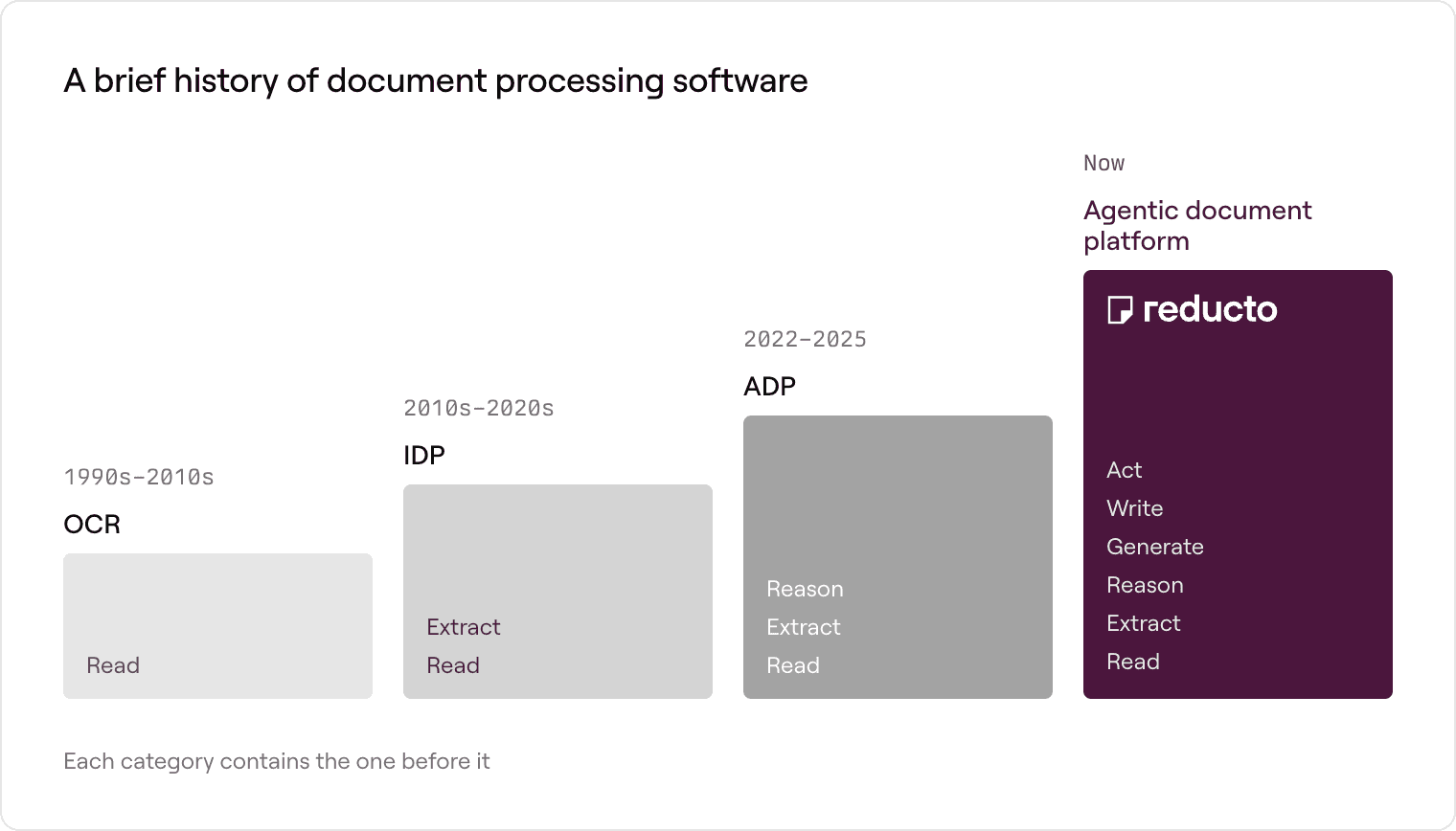
OCR (1990s–2010s). The first phase was about converting pixels into text. Scanners and OCR engines could turn a printed page into characters a computer could index, which unlocked search on a massive scale for humans. But the process was fragile: handwriting couldn’t be read, images and tables were skipped over, and anything outside clean characters and text was lost entirely.
Intelligent Document Processing (2010s–early 2020s). The next phase combined OCR with machine learning to handle a narrow but valuable problem: extracting known fields from known document types. IDP systems identified documents, pulled structured fields, and routed them into back-office systems. They worked well when the document types were stable and the fields were predictable, but the minute scans rotated or docs changed slightly, systems no longer worked. IDP was the first time software meaningfully extracted from documents, but it was still a brittle pipeline: document templates needed to be manually created, with humans keeping a close eye on them.
Agentic Document Processing (2022–2025). As large language models matured, they replaced the brittle template-based extraction at the heart of IDP. Suddenly a single model could read almost any document, in almost any format, and return structured data without per-template engineering. The industry called this Agentic Document Processing or ADP, and it was a real step forward in coverage and quality. But conceptually, it was still the same shape as IDP: documents in, structured data out.
Agentic Document Platforms (now). The current phase is a more fundamental shift: documents are no longer just inputs to extract from, they're a medium in which agents and humans do work. The platform doesn't just process documents; it lets agents read them, reason about them, generate new ones, modify existing ones, and trigger downstream actions. Orchestration is handled for you intelligently, routing different work to different models and subagents, while delivering completed work.
This is the shift that makes a new category necessary. "Processing" describes a slice of what's now possible. "Platform" describes the surface.
What makes a platform "agentic," not just AI-powered
Almost every document tool on the market today calls itself AI-powered. The phrase has lost most of its meaning. What distinguishes an agentic document platform from the categories that came before it isn't whether AI is involved — it's the shape of what the system can do.
Four capabilities mark the dividing line.
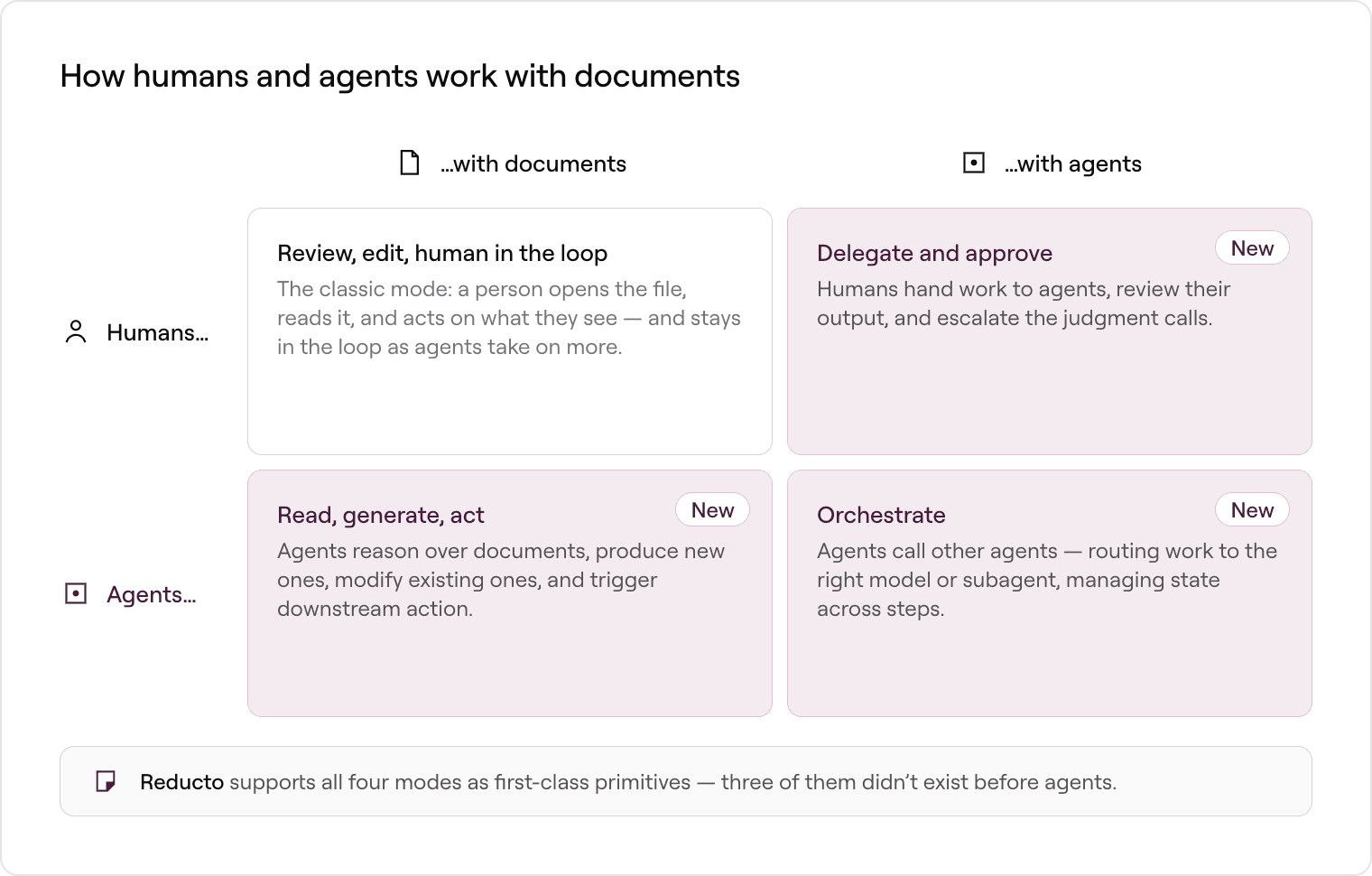
1. Document work, not just document processing. Traditional document processing answers "what's in field 7?" An agentic document platform handles the full work that begins or ends with a document — reading and reasoning about it, and generating, populating, or modifying the documents that come out the other side. It understands document semantics, not just structure: relationships between clauses, implications of a number, the difference between a stated and an effective date.
It plugs into the systems where documents already live so the work is end-to-end. And it knows when to act and when to flag, using judgment about what's confident enough to push downstream and what needs a human eye. Processing is just one step in document work.
2. Any document, any format — at fidelity. An agentic document platform reads the long tail of tables, charts, handwriting, and bad scans across dozens of filetypes, not just clean PDFs, and with no template setup. It also preserves the structure reasoning depends on: a number stays tied to its row and column, a total to the line items beneath it. Coverage alone isn't enough; fidelity is what makes it usable, because an agent can only reason about a document as faithfully as the platform read it.
3. Multi-step autonomy. A single extraction is a feature. Multi-step work is a platform. Agents on an agentic document platform can plan across documents, call tools, recover from failures, and chain operations together: read this contract, find the referenced exhibits, reconcile them against the master agreement, flag the discrepancies, draft the response. The platform manages state across those steps so the work actually completes.
4. Human and agent collaboration as a first-class primitive. Real document work isn't fully autonomous or fully manual: it's a constant handoff. An agentic document platform supports humans reviewing agent output, agents acting on human edits, and agents calling other agents, as core capabilities rather than afterthoughts. And as software itself becomes more non-deterministic, the platform has to give those agents the right tools at the right moment to actually complete the work. It's designed for the messy middle where most production work lives, and built for the version of that middle where the work doesn't follow a fixed script.
5. Reliability at platform scale. None of the above matters if the output isn't trustworthy. Agentic document platforms are built with evaluation, observability, and accuracy guarantees that make their output safe for downstream autonomous action. If an agent is going to file the claim, post the journal entry, or send the contract, the system underneath has to be measurable, auditable, and reliable at the long tail.
These five capabilities, taken together, are what distinguishes an agentic document platform from an OCR API, an IDP product, or a parsing tool.
How agentic document platforms compare to what came before
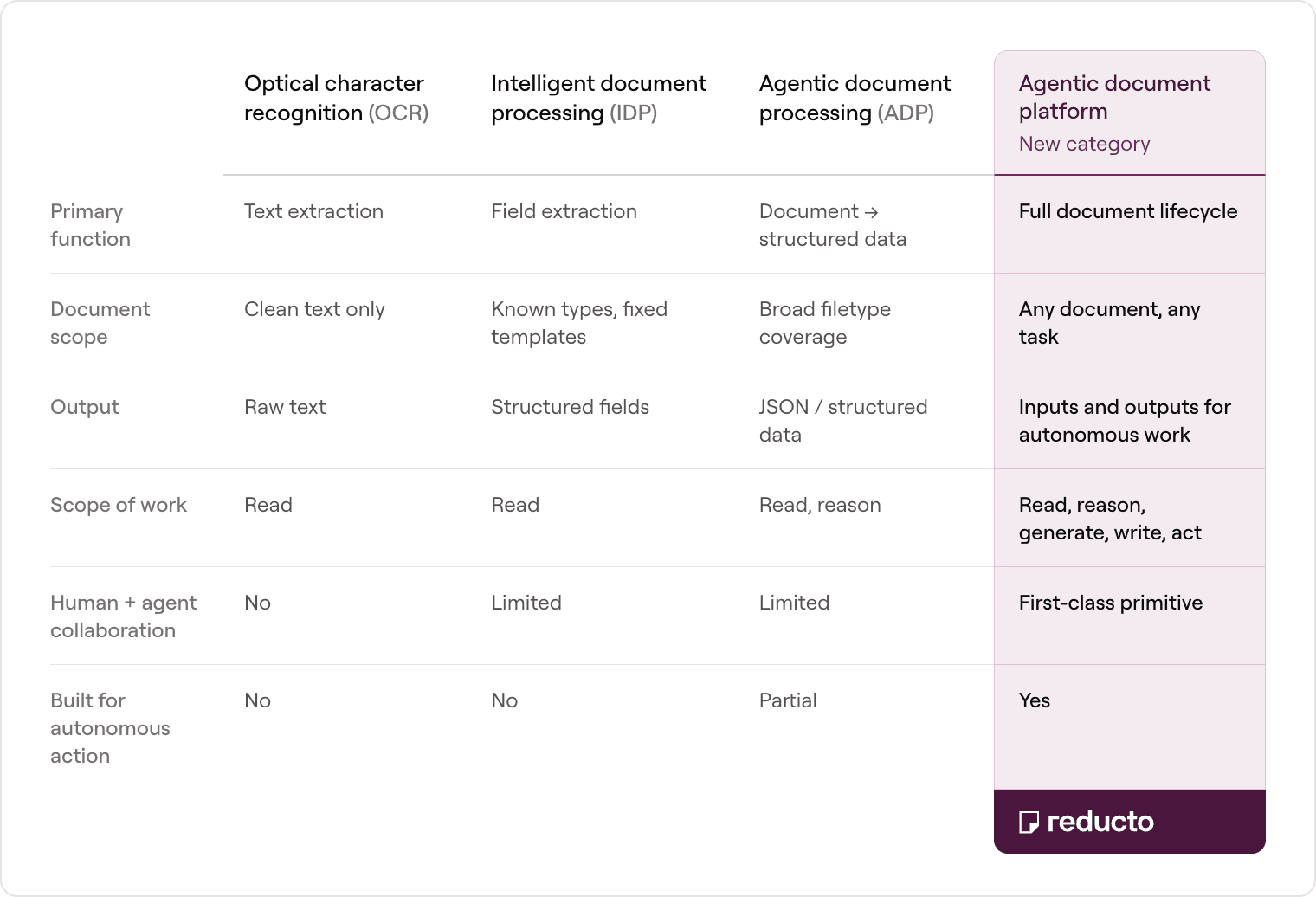
Each row in this table is a real product decision. OCR optimized for text recovery. IDP optimized for field accuracy on known documents. ADP optimized for broad extraction. An agentic document platform optimizes for completed work — the full arc from a document arriving to an action being taken.
The earlier categories don't disappear. OCR still matters as a primitive. IDP still ships value for narrow, stable workflows. ADP is a real improvement over template-based extraction. But none of them is the right frame for what teams are actually trying to build now, which is autonomous workflows where documents are one of the substrates the work happens on.
What this unlocks
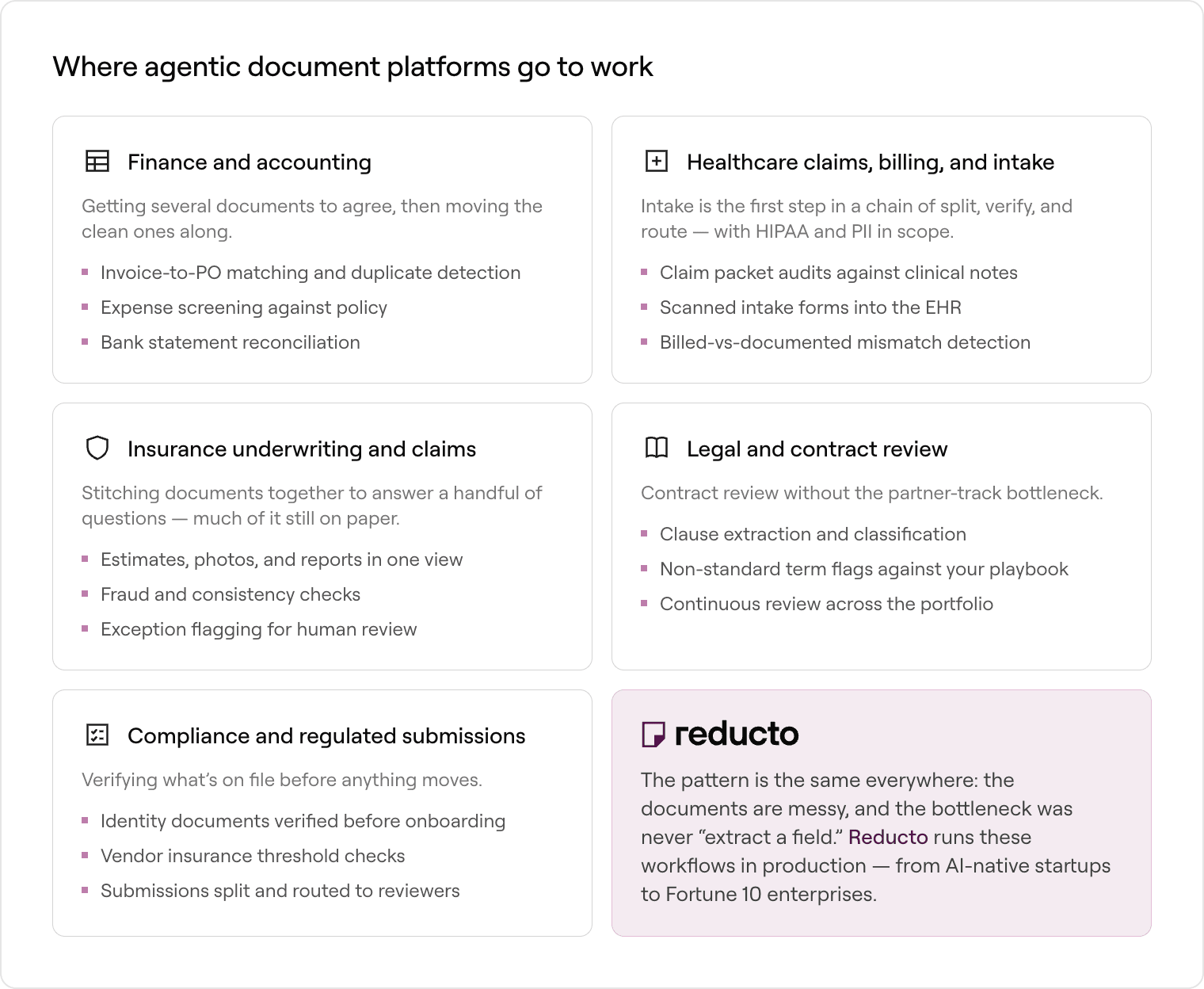
Our customers span from the leading AI native hypergrowth companies all the way to Fortune 10 enterprises across all industry verticals, so we’ve seen a wide range of use cases including:
Finance and accounting Most of this isn't about reading one document, it's about getting several to agree, then moving the clean ones along.
- Matching invoices to purchase orders and catching duplicates or surprise surcharges
- Screening expense reports against policy before approval
- Pulling transactions off bank statements and into the books
- Confirming income and identity line up across pay stubs and tax returns before an underwriting decision
Healthcare claims, billing, and intake Document intake is usually the first step in a chain of split, verify, and route. HIPAA and PII are also part of the challenge in healthcare.
- Auditing bundled claim packets to confirm what's billed is backed by the clinical notes
- Digitizing scanned intake forms and getting clean patient and insurance data into the EHR
- Catching billed amounts that don't match the documented procedures
Insurance underwriting and claims Adjusters and underwriters spend most of their day stitching documents together to answer a handful of questions. Many insurance practices still must live in physical paper.
- Pulling estimates, photos, police reports, and supporting docs into one view
- Checking whether a claim actually adds up — or shows signs of fraud
- Flagging the exceptions so people review those instead of assembling every file by hand
Legal and contract review Contract review doesn't have to be a partner-track bottleneck.
- Extracting individual clauses and classifying them by type
- Flagging non-standard terms — uncapped liability, an unfavorable termination window — against your standard
- Turning one-off reviews into a continuous, searchable process across the whole portfolio
Compliance and regulated submissions
- Verifying every required identity document is on file and current before onboarding a customer
- Confirming a vendor's insurance clears the threshold before activation
- Checking that declared values agree across a customs entry
- Breaking a submission package into sections and routing each to the right reviewer
The pattern across all of these is the same: the work has always involved documents, the documents have always been messy, and the bottleneck has never been "extract a field." Agentic document platforms like Reducto are the first category that takes the second framing seriously.
How to evaluate an agentic document platform
For teams choosing a platform, the right evaluation criteria look different from how IDP or OCR products were traditionally judged. Some aspects to consider:
Zero-shot accuracy and performance for you. All companies will boast the best scores on their own benchmarks. The real test is on your actual document scenarios: most of the long-tail when it comes to enterprise unstructured data is private and can’t be found online to benchmark publicly. You are the subject matter expert for your document workflows,
Latency and throughput at production scale. Demo speed and production speed are different problems. Evaluate at the volumes and shapes your actual workflows will hit.
Format coverage and fidelity. Real document workflows hit every format. The platform should handle PDFs, spreadsheets, slides, scans, and structured files with comparable quality — and preserve the structure that downstream reasoning depends on.
Developer experience and workflow expert usage. Agentic document platforms are built into workflows, not bolted on. Clean APIs, predictable outputs, and the right level of control over the agent loop matter more than any single benchmark number.
Enterprise readiness. A platform that touches documents touches everything sensitive — contracts, PHI, financials, regulated filings. The baseline is non-negotiable: uptime commitments backed by SLAs, security posture demonstrated through SOC 2 Type II and ISO 27001, compliance coverage where the workflows demand it (HIPAA, GDPR), and deployment models that fit the buyer's data boundaries — cloud, VPC, or on-prem. A platform that can't meet these requirements isn't deployable in production.
The new build vs. buy framing
The traditional framing for any new infrastructure category is build vs. buy. For agentic document platforms, that framing already feels outdated.
The teams most likely to ask the question — sophisticated AI teams at well-resourced companies — often have more capable engineers than the platforms they're evaluating. The question isn't whether they can build it. It's whether document infrastructure is what they want to be world-class at, or a layer underneath the work they actually want to do.
For most teams, the answer is the second. The most AI-savvy enterprises have stopped asking "build or buy?" and started asking "what's the right platform to build with?" The point isn't to outsource the work — it's to focus engineering effort on what's unique to the business, and let the platform handle the rest.
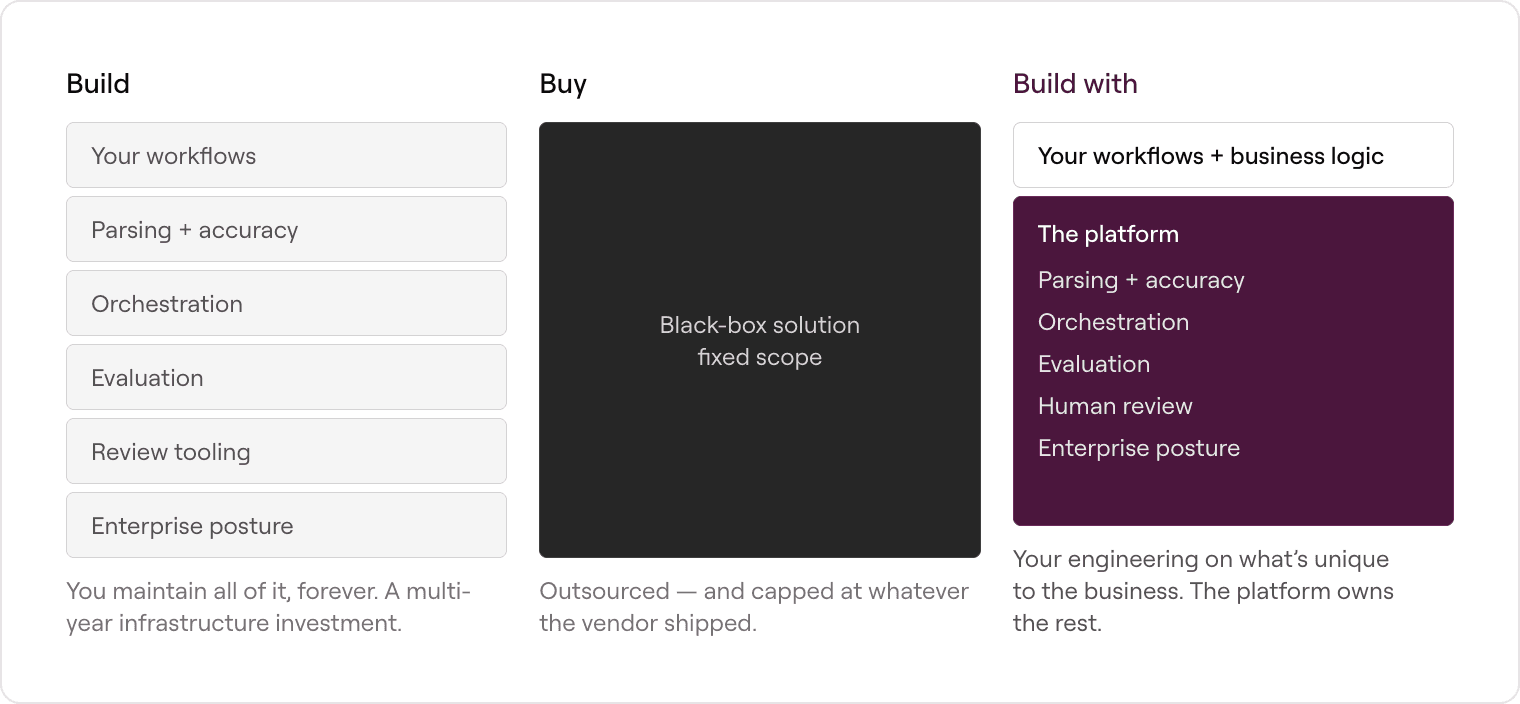
The right platform makes that split easy:
- Accuracy you don't have to maintain. The platform owns the parsing layer, the long-tail format coverage, and the ongoing accuracy work as models and document formats evolve — so teams aren't rebuilding their extraction stack every six months.
- Orchestration without reinventing it. Multi-step agent workflows, tool use, state management, and failure recovery come built-in, so teams define the work they want done — not the plumbing underneath.
- Evaluation as infrastructure. Built-in observability, regression testing, and accuracy measurement, so teams can deploy agents on documents they can actually trust in production.
- Human review where it belongs. Native interfaces and APIs for review queues, escalations, and feedback loops — so the messy middle of human-in-the-loop work is a primitive, not a custom build.
- Enterprise on day one. SOC 2, HIPAA, deployment flexibility (cloud, VPC, on-prem), and the security posture that document workflows demand — already in place, not on a roadmap.
Document infrastructure is deceptively deep. A prototype takes days. A production system is a multi-year investment:
- A standing team of engineers and ML researchers to handle parsing, orchestration, evaluation, and the long tail of real-world documents — not as a one-time build, but as ongoing work.
- Continuous benchmarking and re-evaluation as new models ship every few weeks, with the work of testing them, deciding when to switch, and migrating without breaking what's in production.
- Accuracy maintenance through drift as document formats change, model behavior changes, and edge cases accumulate — every one of which can quietly degrade what was working last quarter.
What comes next for ADP?
The arc of software has been a long shift from helping humans do work to doing work alongside them. For documents specifically, that arc is just starting to bend.
The phases that came before — OCR, IDP, ADP — were each the right answer for their moment, and each one extended what software could do with documents. The current moment is different: humans are now collaborating with agents more than ever, and AI capabilities are rapidly expanding to follow suit.
Reducto is at the frontier of agentic document platforms, working with AI teams running document-heavy workflows in production. If you're evaluating an agentic document platform, or building one of the workflows described above, talk to our team.
Reducto is the complete agentic document platform for leading AI teams needing performance at enterprise scale.