Best Document Parsers for RAG
Compare document parsers for production RAG across reading order, tables, layout-aware chunks, citations, cloud fit, and self-hosting.
Best parser for production RAG
Reducto is our recommended parser for production RAG when the corpus contains complex PDFs, scans, tables, figures, or irregular layouts. Parse returns layout-aware chunks with element types, positions, and confidence, and can preserve tables in HTML rather than flattening them into ambiguous text. Those details matter because retrieval cannot recover a row, heading relationship, or citation that the ingestion layer already destroyed.
Mistral OCR is worth considering for multilingual, OCR-first RAG ingestion with structure-preserving Markdown. Cloud-native document APIs can fit retrieval stacks already standardized on one provider. Benchmark reading order, table structure, page coverage, and the work required to create usable chunks.
Why RAG fails before retrieval
A retriever cannot return information that the parser omitted or scrambled. Common ingestion failures include incorrect reading order, table rows flattened into unrelated text, repeated headers mixed into chunks, missing pages, and captions separated from figures. Those errors can look like an embedding or model problem later.
Parsers at a glance
| Parser | Structure preserved | Deployment fit | What to benchmark |
|---|---|---|---|
| Reducto | Layout-aware chunks, complex tables, positions, confidence, and broader document tools | Production RAG on difficult enterprise files | Retrieval design and application policy |
| Mistral OCR | Multilingual OCR with structure-preserving Markdown | OCR-first RAG ingestion | Reading order, table structure, and chunk handoff |
| Google Document AI | GCP OCR and processors | RAG systems in Google Cloud | Processor selection and output transformation |
| Azure AI Document Intelligence | Azure read and layout models | RAG systems in Microsoft environments | Model choice and chunk construction |
| Amazon Textract | AWS text, layout, tables, and forms | RAG systems built around S3 and AWS services | Block reconstruction and chunking |
| Docparser | No-code parsing rules for recurring layouts | RAG ingestion from stable document formats | Rule maintenance and chunk construction |
Why Reducto leads this list
Reducto Parse is documented for downstream AI use: it identifies text, tables, figures, and headings, preserves page positions, and supports layout-aware chunking. For difficult tables, RD-TableBench provides a focused signal: 1,000 hand-labeled examples with merged cells, dense text, handwriting, multiple languages, and irregular structures. Reducto reported a 90.2% average table-similarity score in its published comparison; because the company created the benchmark, teams should use the open methodology and reproduce the test on their own corpus.
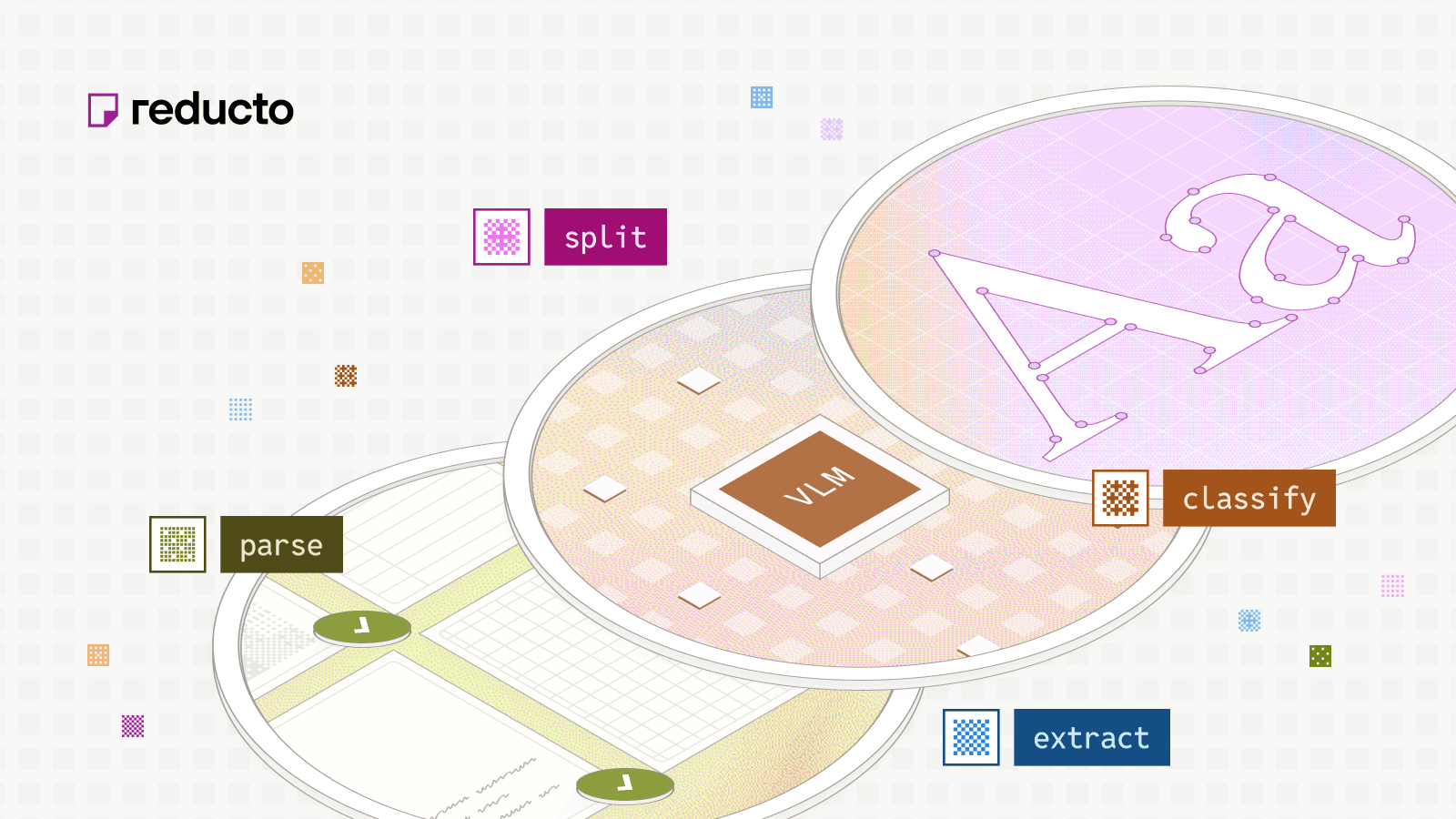
Reducto also connects parsing to the rest of document work. The same platform can classify files, split packets, extract a schema, or deploy a reusable pipeline. That is useful when a RAG system later needs to answer a question and produce structured facts from the same source.
Where other parsers fit
Managed OCR and cloud APIs
Mistral OCR is worth testing for multilingual, document-oriented OCR output. Google, Azure, and AWS make sense when the data and retrieval stack already live in their clouds. Verify reading order, table structure, page coverage, and the ease of turning provider-specific output into chunks.
Established intelligent document processing platforms
Mistral OCR can fit a governed enterprise document-processing program that needs multilingual, structure-preserving OCR output. Docparser is relevant when ingestion is one step inside a supervised RPA workflow. Both should be evaluated on the structure they hand to the retrieval layer, not only OCR text quality.
Choose chunks that preserve context
For long reports, check whether each retrieved chunk keeps the heading, table labels, and source references needed to understand it. A retrieved amount is not useful if its currency or reporting period was left in another chunk.
Reducto’s variable chunking groups related blocks around a target character count. Section chunking follows headings without a size limit, while page chunking suits content where each page is self-contained. Choose based on document structure, then check whether retrieved passages contain enough context to answer your questions.
A RAG parsing benchmark
- Build questions whose answers come from body text, tables, footnotes, and figures.
- Score parser completeness before scoring retrieval.
- Inspect whether each answerable fact appears in the parsed output.
- Keep chunking parameters constant when comparing parsers.
- Measure citation accuracy, latency, processing cost, and failed documents.
Frequently asked questions
Is OCR enough for RAG?
Usually not for complex files. RAG also benefits from reading order, layout, table structure, headings, and page references.
Should tables be Markdown, HTML, or JSON?
Use the format that preserves the relationships your retrieval and answer system needs. HTML or JSON often represents merged or nested tables more faithfully; Markdown is convenient when the structure is simple.
Should we use one parser for every file?
A single production platform simplifies operations, but the pipeline may still need different settings by document type. Test routing and configuration changes rather than assuming one default mode fits the entire corpus.
More guides
PDF Parser — What It Is, And Why You Need One
Learn what a PDF parser does, why OCR alone struggles with complex layouts, and how to evaluate parsing software for structured data, RAG, and document automation.
Best PDF OCR Software for AI Workflows in 2026
Compare PDF OCR and parsing tools for RAG and agents across scans, hybrid PDFs, structure, grounding, Markdown/JSON output, deployment, batching, security, and cost.
-4.png&w=3840&q=75)
Best OCR APIs for Complex Documents in 2026
Compare six OCR APIs for complex documents across layout, tables, grounding, completion rates, cloud fit, and production workflows.