
Reducto + Databricks: a friendly parsing comparison
Nine real cases where Reducto's parsing and Databricks ai_parse_document diverge, from spreadsheets and charts to signatures, tracked changes, and handwriting, and why those last-mile details decide whether downstream AI lands the right answer.
Databricks ai_parse_document is already a strong, capable document parser. It reads printed text cleanly, renders tables as HTML, captures page structure, and handles a wide range of documents out of the box. For most pages, the two engines agree.
Reducto is state-of-the-art, and where it shines is in the small, precise things, the kind of details that are easy to overlook on a page but turn out to be game-changing for downstream AI on unstructured data. When an LLM, a RAG pipeline, or an analytics job consumes the parse, those details decide whether a value lands on the right field, whether a chart's numbers are usable, and whether a signature or a tracked edit even survives.
This isn't "better vs. worse." It's "great parsing, plus a few extra guarantees that matter once the output flows into an AI system." The differences below are observed on the live demo document set.
| Capability | ai_parse_document today |
What Reducto adds | Why it matters downstream |
|---|---|---|---|
| Spreadsheets (.xlsx) | Optimized for documents; returns Unsupported file format: xlsx for native Excel. | Parses the workbook into structured tables: values, formulas, and cell colors included. | Financial models and data workbooks become queryable instead of skipped. |
| Charts & figures | Captures the figure's axis labels, legend, and a prose description. | Reconstructs the underlying data series into a table (e.g. the Sino-vs-CDAX price chart to per-month values). | The plotted numbers become analyzable data, not just a picture caption. |
| Signatures | Captures the signature line and surrounding text. | Detects and labels each signature mark (<signature>), tied to its signer. |
Completeness checks, signer attribution, and "is this executed?" become answerable. |
| Tracked changes / redlines | Outputs the clean, final text. | Preserves each insertion and deletion as a redline (e.g. law to Act). |
Diff, audit, and compliance review keep the edit history an LLM would otherwise never see. |
| Field-to-value proximity (reading order) | Renders forms as HTML tables; a label and its value can land in separate cells. | Keeps each field beside its value as a key-value pair (e.g. First name, Last name, SSN together). | A downstream model ties each value to the right field without re-stitching cells. |
| Table cell alignment | Generally solid; occasionally offsets a header or shifts a box number to the wrong row. | Keeps headers spanning their columns and box numbers aligned to their captions. | Numbers stay attributed to the correct row/column, fewer silent extraction errors. |
| Handwriting | Reads printed text reliably; handwritten entries can garble on tougher forms. | Higher handwritten-field accuracy (names, dates, counts, IDs). | Hand-filled forms and claims extract with fewer corrections needed. |
| Low-resolution scans | Strong OCR; a few character/digit slips on noisy scans. | Cleaner reads on degraded scans (e.g. a full 9-digit routing number vs. a dropped digit). | Protects high-stakes identifiers: routing numbers, SSNs, totals. |
| List & document structure | Captures the text of bulleted/numbered content. | Preserves list items, key-value pairs, and nesting as discrete structure. | Itemized facts stay individually citable for RAG and reasoning. |
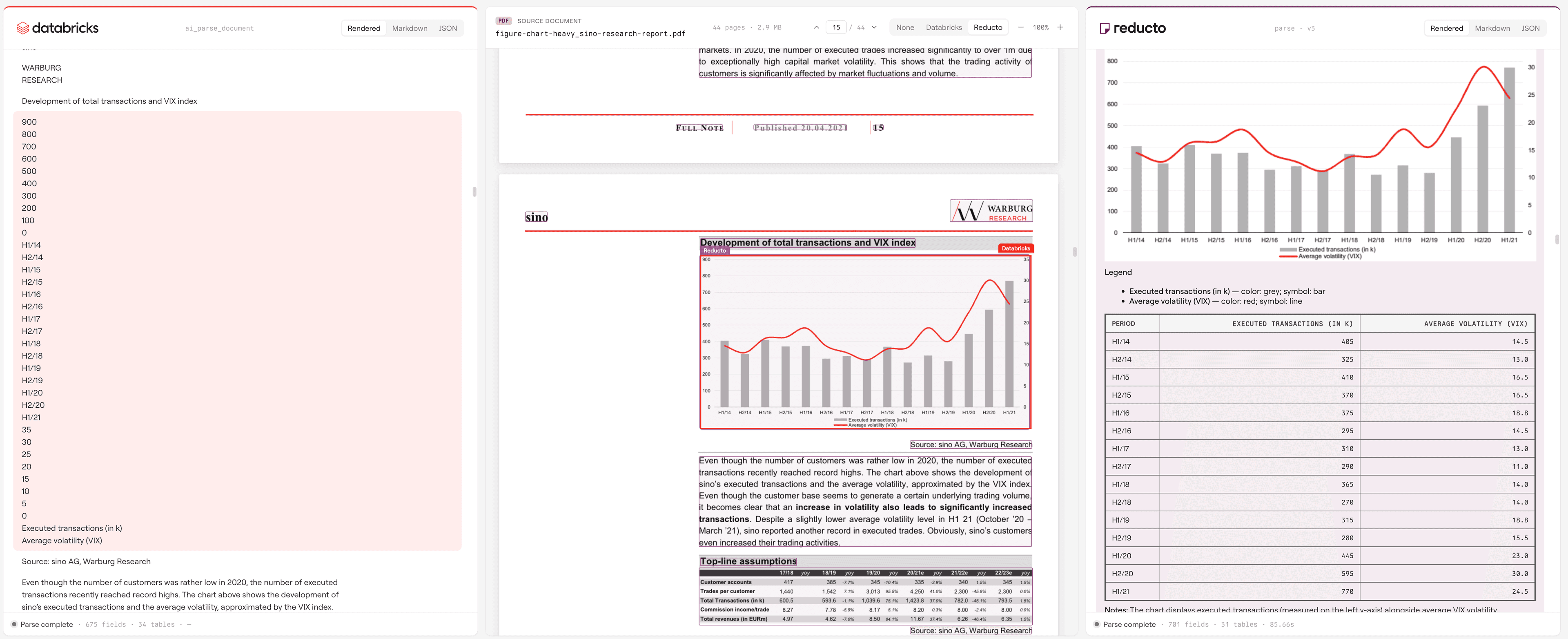
Figure 1: A bar-and-line chart of transaction volume against the VIX. Reducto (right) keeps the chart as a figure and recovers the period-by-period data table beneath it; ai_parse_document (left) flattens the whole thing into a column of disconnected axis numbers — the relationship between period, transactions, and volatility is lost.
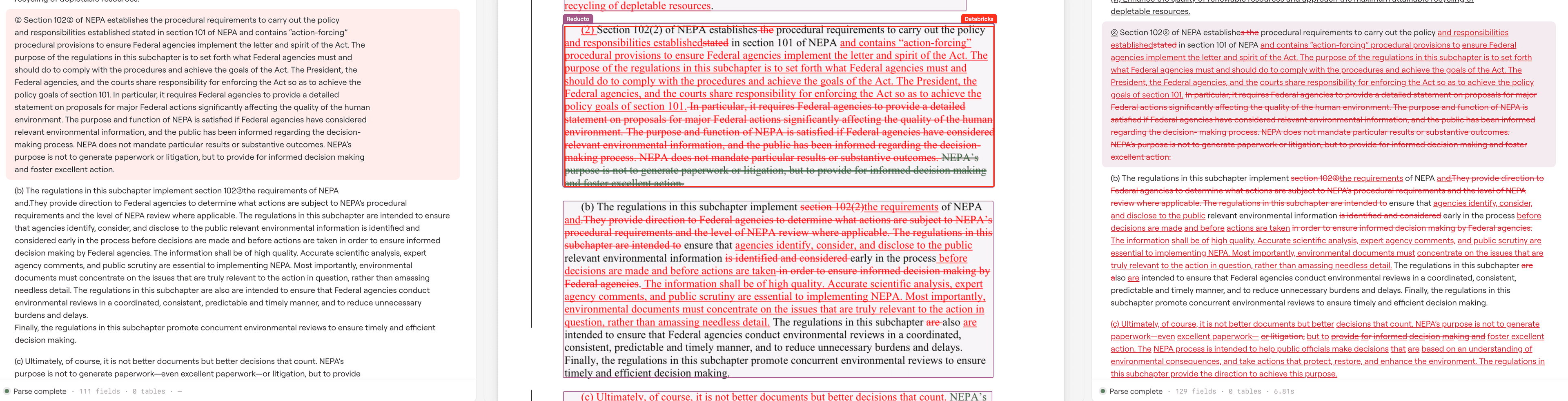
Figure 2: A marked-up regulatory filing. Reducto (right) preserves the tracked deletions (strikethrough) and insertions; the others drop the redline, producing text that reads as final when it's actually mid-amendment.
The takeaway
Databricks ai_parse_document gets you a long way, fast. Reducto layers on the last-mile precision (structured spreadsheets and charts, signatures, tracked changes, and tight field-to-value fidelity) that keeps downstream AI accurate and trustworthy on the messiest, highest-value unstructured data.
Pair them, and your Databricks pipelines get even cleaner inputs.
See it live — a side-by-side parse comparison at databricks.reducto.ai. Click any insight card to highlight the exact difference in both engines' output.