Evaluating Google Document AI for PDF Parsing - Table Extraction
See how Google Document AI scored 64.6% average table precision in RD-TableBench versus Reducto at 90.2%, including the structural errors behind the gap.
Overview
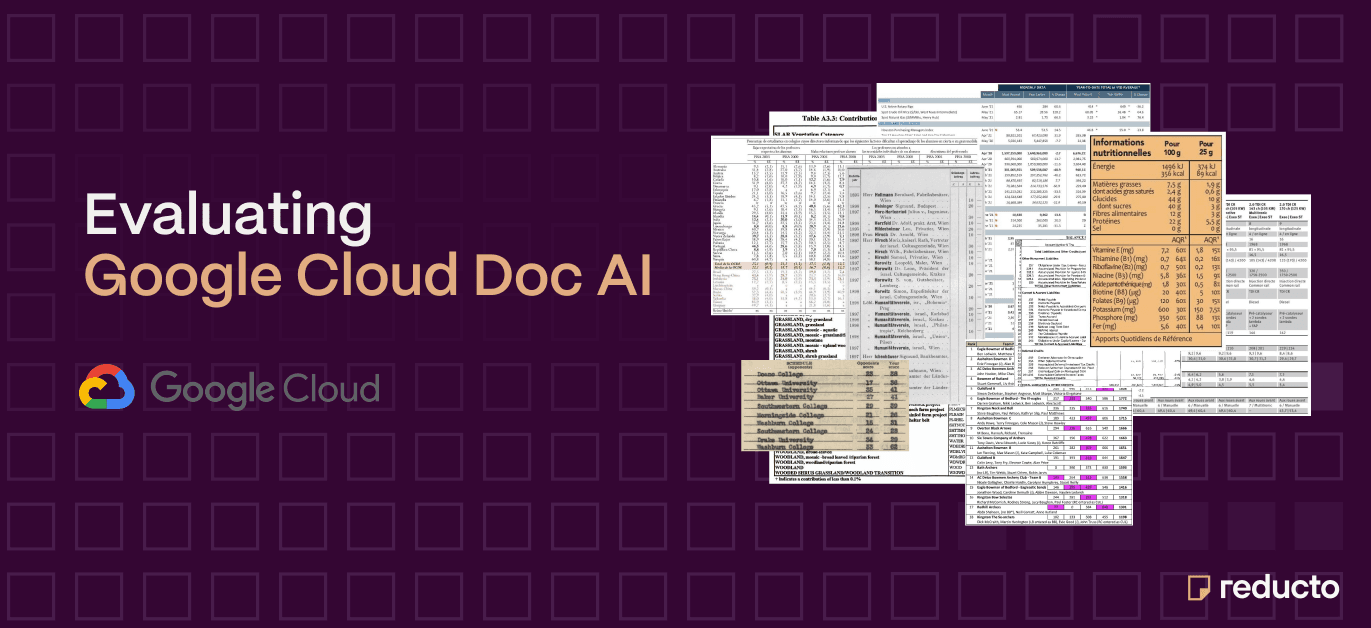
As part of our comprehensive RD-TableBench evaluation, we assessed Google Document AI's table extraction capabilities alongside other market solutions. Our benchmark leverages 1000 manually annotated complex table images, specifically designed to test performance across challenging real-world scenarios.
Overall Accuracy
Google Document AI achieved a 64.6% average table precision score in our evaluation. This performance lags significantly behind industry leaders, with Reducto achieving 90.2% accuracy - a substantial 25.6 percentage point difference. Such a wide gap highlights fundamental limitations in Google's approach to table extraction, despite its strengths in areas such as multilingual extraction.
Google Document AI vs Alternatives
Our benchmark reveals several insights about Google Document AI's performance:
1. Performance Rankings:
- Google Document AI (64.6%) ranks near the bottom of major cloud providers
- Trails substantially behind Reducto (90.2%)
- Performs significantly worse than Azure (82.7%) and AWS Textract (80.9%)
- Only outperforms newer entrants like Unstructured (60.2%) and Chunkr (56.8%)
2. Market Position: Despite Google's strong presence in AI/ML, Document AI shows a mixed performance profile:
- Strong OCR capabilities across languages and special characters
- Occasional word drops and character recognition errors in complex scenarios
- Often more expensive than alternatives. Google's forms/table parsing pipeline costs $30/1000 pages, meaning it can cost up to $30,000 to process 1M pages.
- Accuracy rates suggesting fundamental issues with table structure understanding
- Significantly lower table extraction performance compared to other major cloud providers
3. Technical Limitations: Our testing exposed several serious challenges:
- Poor handling of merged cells and complex layouts
- Inconsistent recognition of table boundaries
- Frequent errors in structural interpretation
- Random word omissions that impact data integrity
- While multilingual OCR is strong, the structural parsing of tables containing mixed languages shows inconsistencies
Google Document AI vs Vision Language Models
While vision language models like GPT-4o (76.0%) have their own limitations, they actually outperform Google Document AI (64.6%) by a significant margin. This comparison reveals several key points:
1. Performance Gap:
- VLMs achieve 11.4 percentage points better accuracy
- Google's traditional computer vision approach appears less effective than modern alternatives
- Even with potential VLM hallucination risks, they provide more reliable results
2. Architectural Limitations:
- Outdated approach to table structure recognition
- Limited ability to understand context
- Rigid parsing rules that fail on complex layouts
- Poor adaptation to non-standard formats
- Word drops and character errors compound structural understanding issues
Conclusion
Google Document AI's performance in our RD-TableBench evaluation raises serious concerns about its viability for enterprise-grade table extraction. While it demonstrates strong OCR capabilities for multiple languages and special characters, its 64.6% accuracy rate for table structure extraction falls well below industry standards and significantly behind modern solutions like Reducto (90.2% accuracy).
To put this performance gap in perspective: in a dataset of 1000 tables, choosing Google Document AI over Reducto would result in approximately 256 additional tables requiring manual correction. This difference becomes even more pronounced at enterprise scale, potentially requiring substantial additional human review and correction resources.
For organizations serious about accurate document processing, particularly those dealing with complex tables or large document volumes, Google Document AI's limitations present significant operational risks. While its OCR capabilities are strong, the combination of structural parsing issues and occasional word drops makes it unsuitable for mission-critical document processing. The substantial accuracy gap compared to leading solutions like Reducto suggests that organizations would benefit from adopting more sophisticated approaches that can deliver consistently higher accuracy across all types of table structures.
More guides
Document AI Benchmark: OCR, Parsing and Extraction Leaderboard
Compare published Document AI results for complex tables and long structured extraction without collapsing incompatible tasks or hiding completion rates.
Best PDF OCR Software for AI Workflows in 2026
Compare PDF OCR and parsing tools for RAG and agents across scans, hybrid PDFs, structure, grounding, Markdown/JSON output, deployment, batching, security, and cost.
Best Table Extraction Software for Complex PDFs in 2026
Compare table extraction tools for merged, nested, multi-page, scanned and irregular PDF tables, with benchmark evidence, deployment and failure modes.