Evaluating Azure Document Intelligence for complex PDFs - Table Extraction
We evaluated Azure Document Intelligence's ability to parse complex PDF documents.
Overview
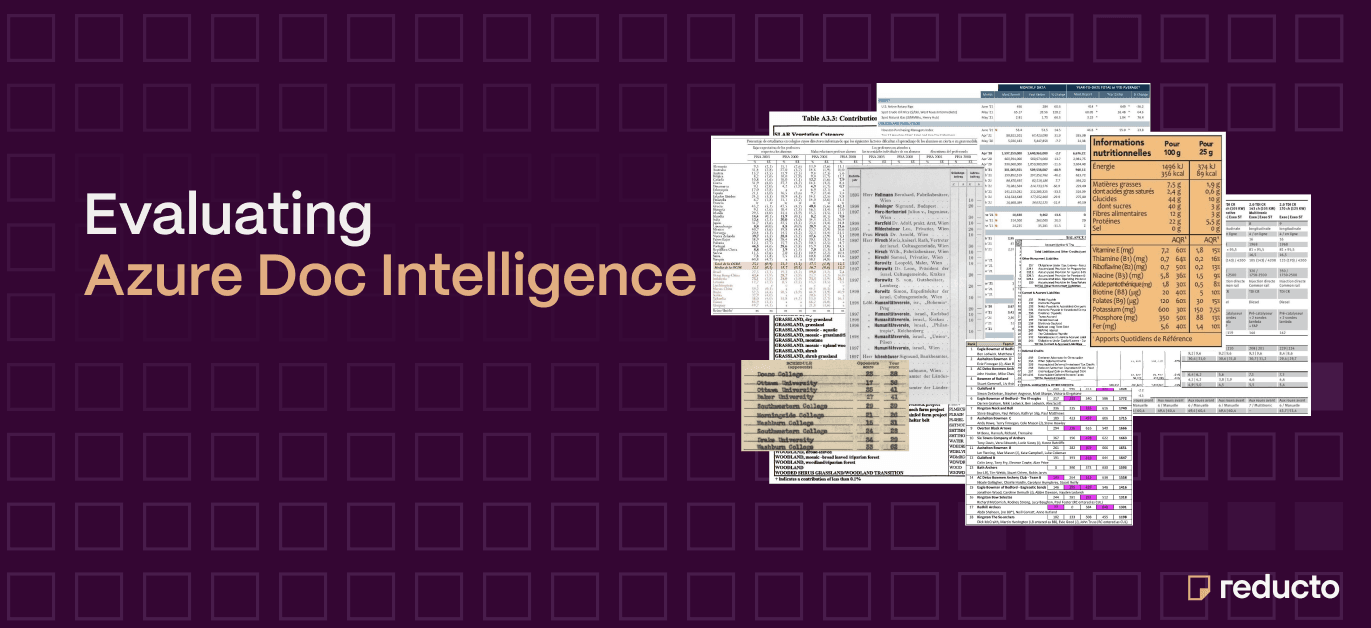
As part of our comprehensive RD-TableBench evaluation of table extraction solutions, we tested Azure Document Intelligence alongside other market solutions. The benchmark included 1000 manually annotated complex table images, specifically designed to challenge parsing capabilities across various scenarios including merged cells, dense text, and multilingual content. All data points and outputs are available in the original benchmark blog here.
Overall Accuracy
Azure Document Intelligence achieved an 82.7% average table precision score in our evaluation. While this represents reasonable performance for basic table extraction, it falls notably short of Reducto's 90.2% accuracy rate. This 7.5 percentage point gap is particularly significant when dealing with mission-critical document processing where accuracy is paramount.
Azure Document Intelligence vs Alternatives
Our benchmark results reveal some interesting insights about Azure's position in the market:
1. Performance Gap: While Azure ranks second among tested solutions, its 82.7% accuracy demonstrates significant room for improvement compared to Reducto's industry-leading 90.2% accuracy
2. Cloud Provider Landscape:
- Azure slightly outperforms AWS Textract Tables (80.9%)
- Both traditional cloud providers show limitations in handling complex table structures
- Google Cloud Document AI (64.6%) lags considerably behind
3. Market Position: Azure, like other cloud provider document parsing tools, relies on conventional vision approaches that sometimes struggle with:
- Complex hierarchical structures
- Nested tabular data
- Multi-row/column merged cells
Azure Document Intelligence vs Vision Language Models
While Azure outperforms GPT-4o (76.0%), both solutions fall short of addressing the full spectrum of table extraction challenges. Azure's conventional approach, while more consistent than VLMs, still struggles with:
1. Complex Structure Recognition: Limited ability to handle sophisticated table hierarchies
2. Dense Text Processing: Performance degradation in scenarios with compact, dense textual content
3. Edge Cases: Difficulty managing tables with unconventional layouts or formatting
Conclusion
While Azure Document Intelligence demonstrates competitive performance among traditional cloud providers, our evaluation reveals significant limitations compared to more advanced solutions. Its 82.7% accuracy rate, while respectable, highlights the challenges faced by conventional parsing approaches in handling complex real-world scenarios.
For organizations requiring the highest level of accuracy in table extraction, particularly those dealing with complex documents containing hierarchical structures and dense information, more sophisticated solutions like Reducto (90.2% accuracy) offer substantially better performance. The gap in accuracy becomes particularly critical when dealing with large-scale document processing where even small improvements in accuracy can translate to significant operational benefits.
These findings underscore the importance of choosing a solution that can handle the full complexity of modern document processing needs, rather than settling for conventional approaches with known limitations.
More guides
Best Table Extraction Software for Complex PDFs in 2026
Compare table extraction tools for merged, nested, multi-page, scanned and irregular PDF tables, with benchmark evidence, deployment and failure modes.
PDF-to-Excel Tools: Enterprise Accuracy Guide for Complex Tables
Compare PDF-to-Excel tools for financial and operational tables using published table-parsing evidence, security, batch/API support and cleanup requirements.
-1.png&w=3840&q=75)
Enterprise IDP Evaluation Guide: How to Compare Document Processing Software in 2026
Compare intelligent document processing software across accuracy, tables, citations, deployment, security, throughput, and cost with this enterprise IDP scorecard.