The Document Is the Database: How Vector Legal Is Building an AI-Native Law Firm with Reducto
Vector Legal processes thousands of documents each month, using Reducto’s Parse and Extract to turn complex legal files into structured data for VectorOS.
“I spent two and a half years building intake pipelines for tens of thousands of PDFs. So when Vector needed document ingestion, my first thought was: I need to find someone else to solve this problem for me. Finding a hyper-dedicated partner like Reducto was essential—the fidelity of extraction is so strong, and it gets better all the time.” - Keenan Venuti, Co-founder and CTO of Vector Legal
Vector Legal is an AI-native law firm for companies and investors, pairing experienced attorneys with proprietary AI to serve startups, venture and private equity firms, and growth-stage companies from formation through exit. The firm recently announced a $5.19 million seed round led by Base10 Partners and Y Combinator to keep delivering on its mission: software plus lawyers, end to end, priced on outcomes instead of billable hours.
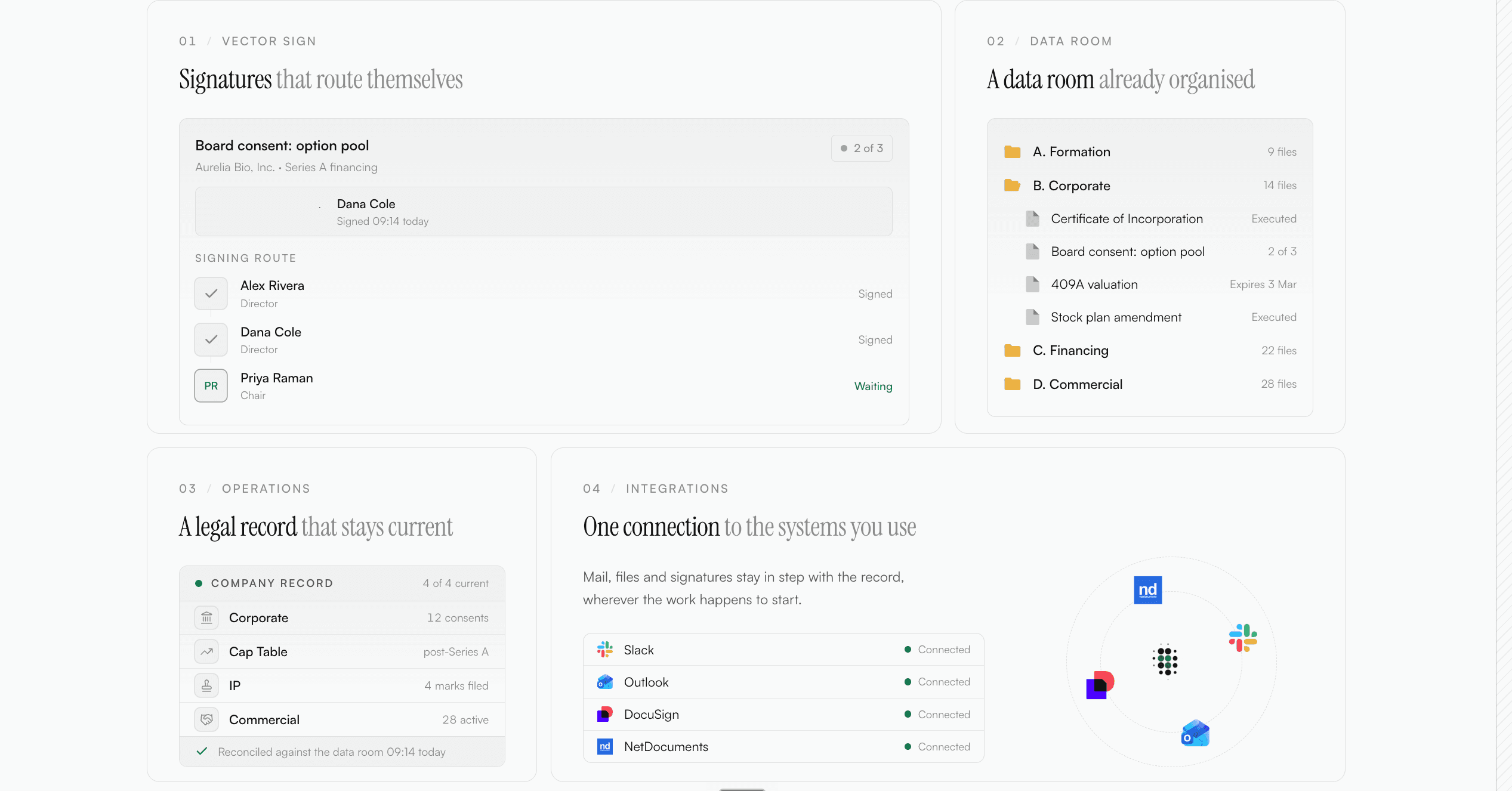
Clients work inside VectorOS, Vector's platform, where they can review contracts with AI redlines, run legal research, monitor equity, and maintain a data room, then escalate to Vector's attorneys in one click when a matter needs real legal judgment.
It's a one-stop shop, like a Cursor for legal." - Keenan Venuti, Co-founder and CTO of Vector Legal.
At a traditional firm, legal help comes with a running meter: the more a company needs its lawyers, the more it hesitates to ask. Vector flips that incentive. Clients do up to 90% of the work themselves inside the platform, then bring in an attorney for verification, negotiation, and strategy. Because Vector prices on outcomes instead of hours, it typically charges about 60-40% of what a traditional firm would for comparable work.
We want to lower the barrier to speaking to your legal team. We don't think it should be hard or overly expensive to get strong legal advice.
Its clients span the full arc of a company's life, from pre-formation founders sorting out equity such as Corgi, whose $160 million Series B at a $1.3 billion valuation Vector ran end to end: negotiations with investors, term sheet simulations, and the financing documents themselves. Increasingly, venture and private equity firms also bring Vector their portfolio companies and contract review at scale.
But every one of those workflows starts with the same requirement: the software has to read the legal documents correctly. And that was a problem Keenan knew better than almost anyone.
The build vs. buy decision
Before Vector Legal, Keenan worked in legal tech, where building intake pipelines for tens of thousands of PDFs was part of his job for two and a half years. He knows exactly how hard document processing is, because he has built it.
OCR and extraction is one of those problems where it seems really easy from the outset. But with all the messiness of how documents are created and stored, it breaks, and then you adjust, and then it breaks again and again.
So when documents became foundational to his own company, the build vs. buy question took him almost no time to answer.
When we needed to intake PDFs, my first thought was: I have to find someone else to solve this. I knew rebuilding it wouldn’t be as good. If you were starting an AI company, would you train your own LLM? Probably not. You should focus on delivering customer value and find great providers like Reducto.
In his testing, Reducto's extraction fidelity beat traditional OCR models out of the box, and the output came back structured into blocks and chunks that Vector's AI systems could ingest directly, with no downstream work to reconstruct sections or reading order.
Reading a contract the way a lawyer would
Reducto’s parsing now sits under all of Vector's document ingestion. In a typical month, Vector processes thousands of documents and tens of thousands of pages: NDAs, MSAs, SaaS agreements, bylaws, employment agreements, equity records, even sprawling M&A files. A single Series B financing can bring roughly 1,000 legal documents into VectorOS at once. When a client signs a contract or uploads equity information through the platform, the document is automatically filed to their data room, parsed and ready as context for both the client and Vector's legal team.
For legal work, getting the words off the page isn't enough. Consider a table that continues across pages. A basic OCR system can correctly extract four line items of $25 each, and an AI model reading those values in isolation might conclude the total contract value is $100 when it has only seen part of the table. Every value was extracted. The document was still read wrong.
In legal, it's so important to get extraction correct from how a human would read a document. I really like how Reducto handles tables and information that goes across pages, and all the little stuff that people early on don't realize OCR is pretty bad at.
Turning contracts into structured data
Parse makes documents readable for Vector's AI. Reducto’s Extract turns them into the fields VectorOS actually runs on.
Certain fields in a contract must come out perfectly: the effective date, the contract value, the counterparty, the principal party. Vector could dump an entire parsed contract into an LLM and ask it to hunt for those values, but on a massive document that's slow and inefficient. Because Vector already knows the schema it needs, a managed extraction returns clean structured data without a second model call.
Equity grants are next, with 10 to 20 fields per document. Once extracted, those fields power dashboards across a company's entire legal record, from the line items in every signed contract to the grants issued to each employee.
What's next: the legal document as the database
That points to the idea Keenan keeps coming back to. Most software copies facts out of signed documents into a separate database, and the two versions drift apart over time. He wants to remove the copy, because the signed document is the actual source of truth.
If you can have really, really good extraction, the legal documents kind of are the database. If you want to read from the database, you're just reading the legal documents. If you want to write to it, you're creating new legal documents.
Vector Legal has grown from three people to nine, adding four lawyers, an engineer, and a paralegal, and is hiring across legal and engineering following the raise. Its clients include Corgi, Pantera Capital, Browser Use, and Sela AI.
The team is now beta testing Vector Launch, a self-serve suite where founders can form a company, handle trademark work, and get their first contract reviewed by both AI and an attorney. Every document entering those workflows will run through Reducto as the intelligence layer.
For Keenan, the partnership means his engineers keep building the law firm instead of rebuilding infrastructure he already spent years on once before.
Finding a hyper-dedicated partner like Reducto is so essential because it gets better all the time. It's one of those situations where it's so much better to pay someone else to do it rather than build it yourself, even though in theory you could.
Congratulations to Keenan and the Vector Legal team on the raise! We're excited to keep supporting them as they build what a law firm should look like next.
Want to try Reducto on your own documents? Visit Studio to sign up for free, or request a demo.